
Hvar sits 50 kilometers southwest of Split across open Adriatic water but the distance is not what trips people up the route options. Type “Split to Hvar” into any search engine and you will find conflicting information: one hour, two hours, car ferry, catamaran, Stari Grad, Hvar Town. Most travelers arrive at Split harbor already confused and that confusion costs them time and sometimes money.
This guide cuts through all of it. There are two main routes from Split to Hvar, three operators worth knowing and a handful of details that determine whether your crossing is smooth or frustrating. Whether you are planning a day trip or a week-long stay on the island, the decisions you make before boarding that ferry set the tone for everything that follows.
By the time you finish reading, you will know exactly which ferry to take, when to book it, what it will cost and how to get around once you land on Hvar. No guesswork, no vague summaries, just the specific information you need to move.
In This Guide You Will Find:
- The exact difference between the catamaran to Hvar Town and the car ferry to Stari Grad and which one to choose
- Real ticket prices in EUR for every route and operator
- Why bringing your car to Hvar costs more than it saves
- The one morning ferry slot that lets you beat the summer crowd by two hours
- What to do when July and August ferries sell out before you even wake up
- How Split to Hvar compares to Split to Brač and which island suits which traveler
Quick Info
| Detail | Info |
| Route | Split → Hvar Island, Croatia |
| Sea Distance | ~50 km |
| Fastest Option | Krilo Catamaran 1 hour to Hvar Town |
| Slowest Option | Car ferry via Stari Grad 3+ hours total |
| Cheapest Ticket | €5–€7 passenger (car ferry) |
| Best Months to Travel | May, June, September |
| Recommended Stay on Hvar | 2–4 days |
| Average Daily Cost on Hvar | €80–€130 per person |
Split to Hvar: The Two Main Routes You Must Understand
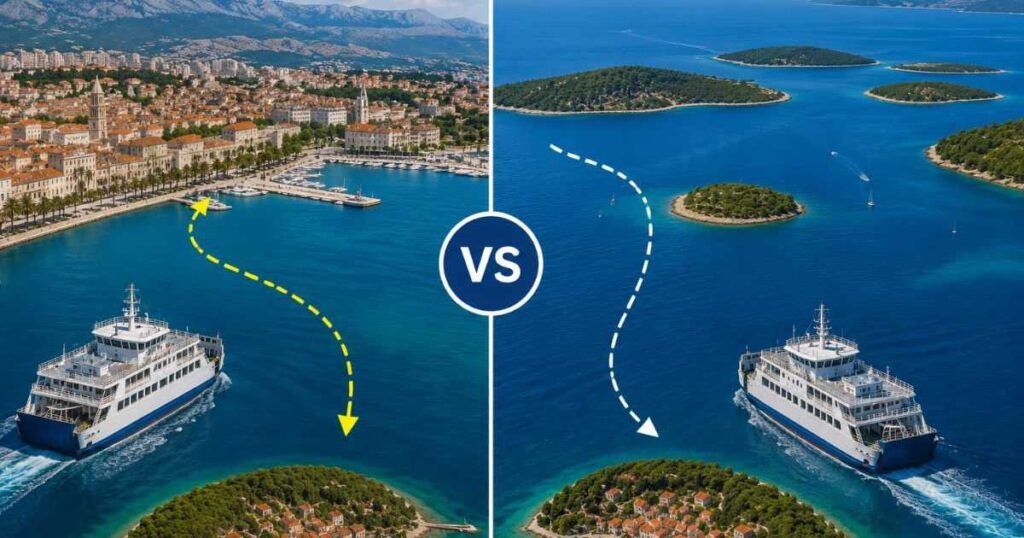
Most first-time travelers arrive in Split, open Google Maps, search “Split to Hvar ferry” and immediately get confused because there is not one route. There are two completely different routes serving two different purposes and picking the wrong one wastes hours.
Route 1: Split → Hvar Town (Catamaran, passengers only) Jadrolinija and Krilo both run high-speed catamarans from Split’s Riva harbor directly to Hvar Town. The Krilo catamaran takes about 1 hour and Jadrolinija takes around 1 hour 10 minutes. A one-way passenger ticket costs roughly €8–€12. No cars are allowed you travel on foot and sit inside an air-conditioned cabin or on the open upper deck.
Route 2: Split → Stari Grad (Car Ferry) If you need to bring a vehicle, the Jadrolinija car ferry departs from Split Port about 5 km north of the Old Town and docks in Stari Grad on Hvar’s north coast. The sea crossing alone takes 2 hours. From Stari Grad, you still need 30 minutes by road to reach Hvar Town, so total door-to-door travel time with a car is closer to 3 to 3.5 hours.
For travelers without a car, the catamaran wins every time. It is faster, it drops you directly in Hvar Town next to the main square and harbor and it costs less per person than bringing a vehicle. The car ferry makes practical sense only if you plan to explore Hvar’s inland villages, the lavender fields near Velo Grablje or the eastern tip of the island near Sućuraj.
One detail most tourists do not realize: the car ferry terminal in Split is not at the Riva harbor where the catamarans leave. It is at Split Port (Luka Split), roughly 5 km away 15 to 20 minutes by taxi (around €10) or Bus Line 37 from the city center (€2 per ride, runs every 30 minutes).
Pro Tip: Book your catamaran ticket 2–3 days ahead in July and August both Krilo and Jadrolinija sell out by mid-morning on peak summer days. Buy directly on jadrolinija.hr or krilo.hr to avoid third-party booking fees.
Split to Hvar Ferry Prices: What You Will Actually Pay
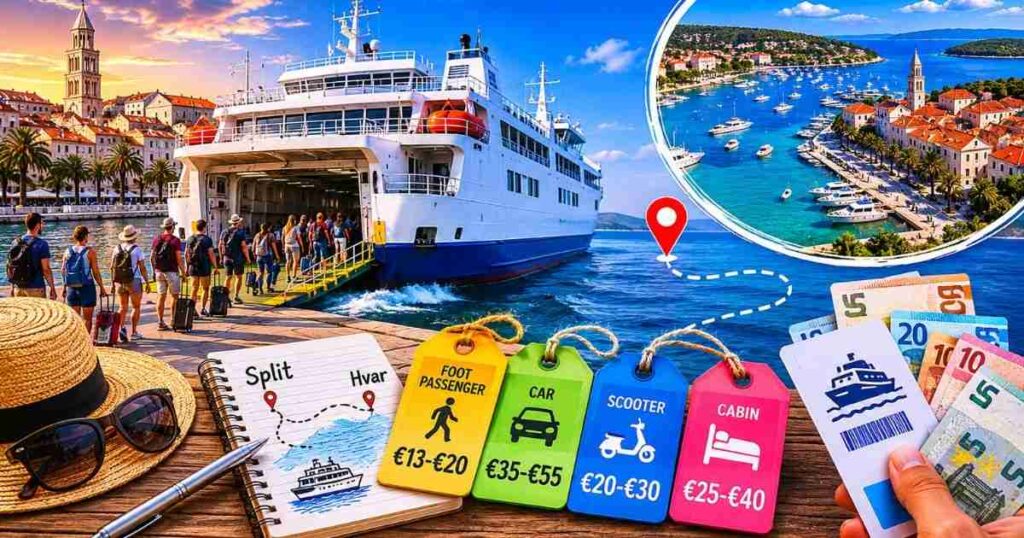
Ticket prices on the Split to Hvar route vary by operator, season and whether you book in advance or walk up to the port on the day.
Jadrolinija Catamaran: A one-way passenger ticket from Split to Hvar Town costs approximately €8–€10 in peak season (June through August). Off-season fares from October to April drop to around €6–€7. Children under 12 pay roughly half price.
Krilo Catamaran: Slightly faster and slightly pricier. Expect to pay €10–€13 one way in summer. Krilo runs newer vessels with more comfortable seating and reliable air conditioning, a meaningful difference on a hot August afternoon when the crossing takes a full hour.
Car Ferry (Split to Stari Grad): A passenger-only ticket on the car ferry costs around €5–€7. Bringing a standard car adds approximately €28–€35 on top of that in high season. A motorcycle costs roughly €12–€15 extra.
One cost that surprises many travelers: the Split to Hvar route does not include a return ticket. You buy one-way in each direction. A day trip from Split to Hvar on the catamaran costs a minimum of €16–€24 in transport alone before food, any entrance fees or the water taxi to the Pakleni Islands.
Pro Tip: The Krilo catamaran continues beyond Hvar Town to Korčula and Dubrovnik on selected schedules. If your itinerary includes multiple Dalmatian islands, check whether a through-ticket saves money compared to buying each leg separately.
Split to Hvar Travel Time: Honest Breakdown by Every Option
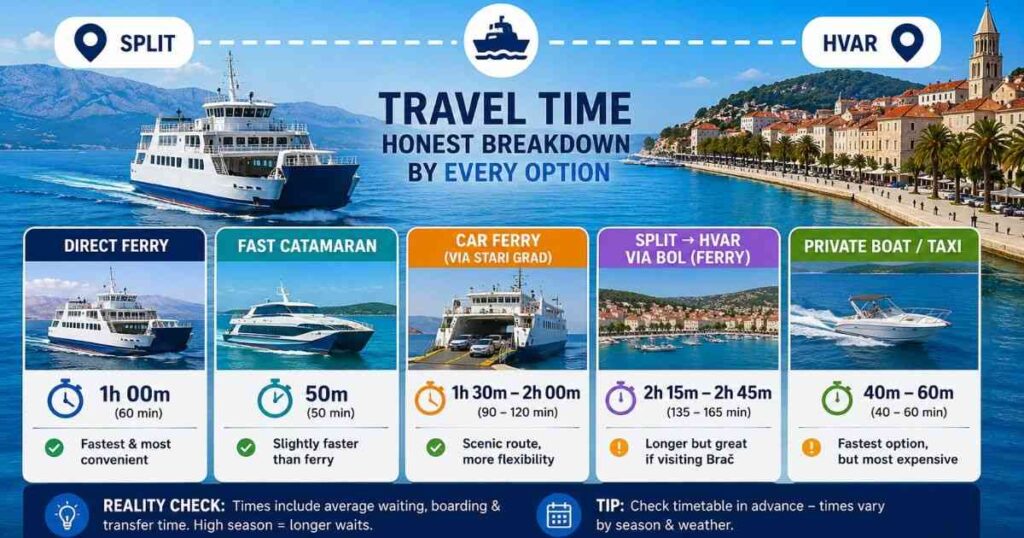
The phrase “one hour from Split to Hvar” is technically accurate for the catamaran but your real door-to-door time depends on where you start in Split, how early you need to check in and exactly where on Hvar you are heading.
Catamaran from Split Riva to Hvar Town: Walk-in check-in opens 30 minutes before departure. Add 10–15 minutes to walk from most Split Old Town hotels to the Riva waterfront. Total travel time from your hotel door to stepping off in Hvar Town: roughly 1 hour 45 minutes.
Car Ferry from Split Port to Stari Grad: The sea crossing takes 2 hours. You must arrive at the terminal 30–45 minutes early to queue your vehicle. Then add 30 minutes by road from Stari Grad to Hvar Town. Total: 3 hours minimum, often 3.5 hours in summer when vehicle queues stretch long.
Private Speedboat or Water Taxi: Several operators run private transfers from Split harbor to Hvar Town in 45–55 minutes. Prices start at €80–€100 per boat not per person making this genuinely cost-effective for groups of four or more. Companies like Hvar Speedboat Transfer and Split Tours both operate this route regularly.
Organized Day Tour from Split: Many Split-based tour operators sell guided day trips to Hvar for €35–€60 per person, including ferry transport, a walking tour of Hvar Town and sometimes a stop at the Pakleni Islands. The tradeoff is a fixed schedule you return to Split by early evening, leaving only 4–5 hours on the island itself.
Verdict: For most independent travelers, the Krilo or Jadrolinija catamaran is the clear best choice, fast, affordable and drops you exactly where you want to be.
Getting Around Hvar After You Arrive
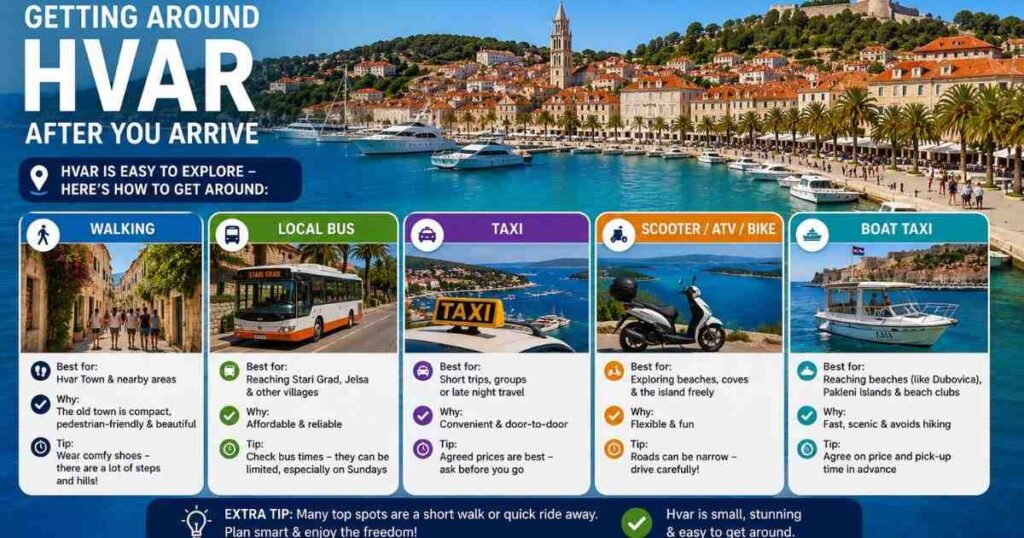
Arriving in Hvar Town by catamaran puts you in the right spot immediately but knowing what you can and cannot reach on foot changes how you plan your days on the island.
Hvar Town itself is compact and fully walkable. The main square (Trg Sv. Stjepana), the harbor promenade, the Spanish Fortress (€5–€8 entry) and most restaurants sit within 10–15 minutes of where the catamaran docks. The Pakleni Islands, a cluster of small wooded islands directly opposite the harbor are reachable by water taxi for €3–€5 each way and offer some of the clearest swimming water in the entire Adriatic.
Traveling east along the island to villages like Jelsa or Vrboska requires a local bus (around €3–€5 per trip) or a rental car. Car rentals in Hvar Town start at roughly €45–€60 per day in summer from operators near the ferry landing. Scooter rental costs €25–€35 per day and is one of the most practical ways to reach the lavender fields in the island’s interior. Peak bloom runs from late May through late June and draws almost no tourist crowds compared to the harbor.
If you arrive via the car ferry in Stari Grad with your own vehicle, you have the most flexibility. The road from Stari Grad to Hvar Town (D116) passes through olive groves and past a viewpoint over the Stari Grad Plain, a UNESCO World Heritage site that dates back to ancient Greek colonization in the 4th century BC.
Most visitors who take the catamaran never leave Hvar Town, which means the rest of the island stays genuinely quiet even in peak July and August.
Pro Tip: Water taxis to the Pakleni Islands stop running around 7:00 PM in summer. If you want to stay for sunset on Palmižana island, arrange a private return transfer in advance or accept swimming back which is not as far as it sounds but plan for it either way.
You may also like:
Frequently Asked Questions
How long is the ferry from Split to Hvar?
The Krilo or Jadrolinija catamaran from Split to Hvar Town takes approximately 1 hour. The car ferry from Split to Stari Grad takes 2 hours and you still need 30 additional minutes by road to reach Hvar Town. Always verify the timetable for your specific travel date since schedules change between summer and off-season.
Do you need to book the Split to Hvar ferry in advance?
In July and August, yes book at least 2–3 days ahead because both catamarans sell out quickly, often before noon on the day of travel. From September through May, walk-up tickets are usually available the same day without issue. Book directly on jadrolinija.hr or krilo.hr to avoid the booking fees that third-party sites add.
Can you take a car on the ferry from Split to Hvar?
You can bring a car on the Jadrolinija ferry from Split to Stari Grad only not on the catamarans that go to Hvar Town. A standard car adds approximately €28–€35 to the passenger fare in high season. For most travelers, renting a car or scooter on Hvar after arriving by catamaran costs less and involves far less waiting in vehicle queues.
Is a day trip from Split to Hvar worth it?
A day trip is possible but gives you roughly 4–5 hours on the island if you take the first morning catamaran and the last one back. Two nights on Hvar gives you time to visit the Pakleni Islands, walk up to the fortress at sunset and explore beyond the main harbor crowd. If your schedule only allows one day, take the earliest catamaran departure available.
Is Split to Hvar better than Split to Brač?
Split to Hvar and Split to Brač serve different types of travelers. Brač is closer the car ferry to Supetar takes just 50 minutes and suits families looking for long sandy beaches like Zlatni Rat near Bol, the most photographed beach in Croatia. Hvar has a more developed restaurant and nightlife scene and attracts a younger, more social crowd. Both islands work as day trips from Split but Hvar rewards a longer stay more than Brač does.
Conclusion
The Split to Hvar crossing is one of the most straightforward island hops in the Mediterranean once you understand which route does what. Skip the car ferry unless you genuinely need a vehicle on the island, book the catamaran ahead of time in peak summer and give yourself at least two nights to see more than just the harbor. The moment the catamaran clears Split’s waterfront and Hvar’s dry limestone hills begin rising out of the sea ahead of you, the planning stops mattering. Book the first morning catamaran departure, walk straight from the dock to a cafe on Trg Sv. Stjepana, order a coffee before the crowds arrive and let the island set the pace from there.

