
Most people treat Dubrovnik as the obvious answer when someone says “Croatia.” That assumption costs them money, comfort and a better experience. Split is not Dubrovnik’s smaller sibling it is a different kind of city entirely, built around a 1,700-year-old Roman palace where people still live, eat and hang laundry. This guide breaks down Split vs Dubrovnik across cost, crowds, beaches, history and daily feel so you can make the right call for your trip.
In This Guide You Will Find:
- Exact daily costs in Split vs Dubrovnik, including meals, accommodation and entry fees
- Which city has better beaches and how far they are from the center
- How crowds differ between June and September in both cities
- What most tourists miss inside Diocletian’s Palace in Split
- Why Dubrovnik’s walls cost €35 to walk and whether they are worth it
- A clear final verdict on which city suits which type of traveler
QUICK INFO BOX
| Split | Dubrovnik | |
| Location | Central Dalmatian Coast, Croatia | Southern Dalmatian Coast, Croatia |
| Nearest Airport | Split Airport (SPU) 25 min drive | Dubrovnik Airport (DBV) 20 min drive |
| Best Time to Visit | May–June, September | May, September–October |
| Travel Time Between Cities | 4.5 hrs by ferry, 4 hrs by bus | Same |
| Days Recommended | 3–4 days | 2–3 days |
| Average Daily Cost | €80–€110/person | €110–€150/person |
Split vs Dubrovnik: City Character and First Impressions
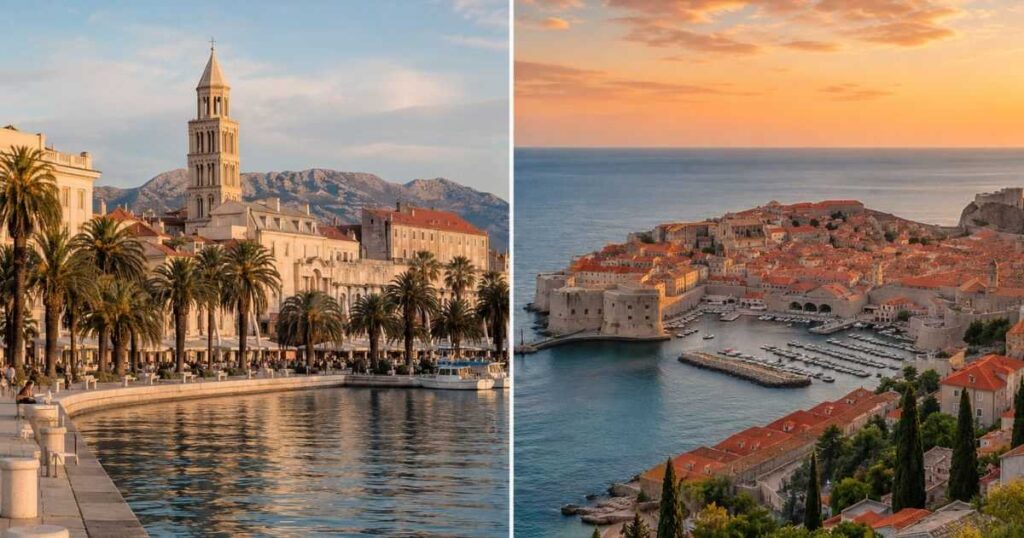
The moment you walk into Split’s Diocletian’s Palace, you realize this is not a museum, it is a living neighborhood. Restaurants, apartments and a cathedral occupy the same 4th-century Roman walls that Emperor Diocletian built as his retirement home. The palace covers 31,000 square meters and houses roughly 3,000 residents today. Dubrovnik, by contrast, has almost entirely tourist infrastructure inside its old town walls hotels, restaurants and souvenir shops fill nearly every building.
Split has a real, functioning city around the palace. The Meštrović Gallery sits 2 km west of the palace. The Marjan Hill forest park gives you a 178-meter viewpoint over the Adriatic with almost no tourist crowds. Dubrovnik’s old town is 2 km of enclosed medieval streets where the resident population has dropped from 5,000 in 1991 to under 1,500 today most locals moved out because rent from tourism pays better than living there.
If you want a city with actual Croatian daily life happening alongside the history, Split delivers that. If you want an architecturally near-perfect walled medieval city on a cliff above the sea, Dubrovnik is unmatched. Both are legitimate goals, they are just not the same experience.
Verdict: Split feels like a city that happens to have a Roman palace inside it. Dubrovnik feels like a palace that has been turned into a city for tourists.
Split vs Dubrovnik: Beaches and Coastline
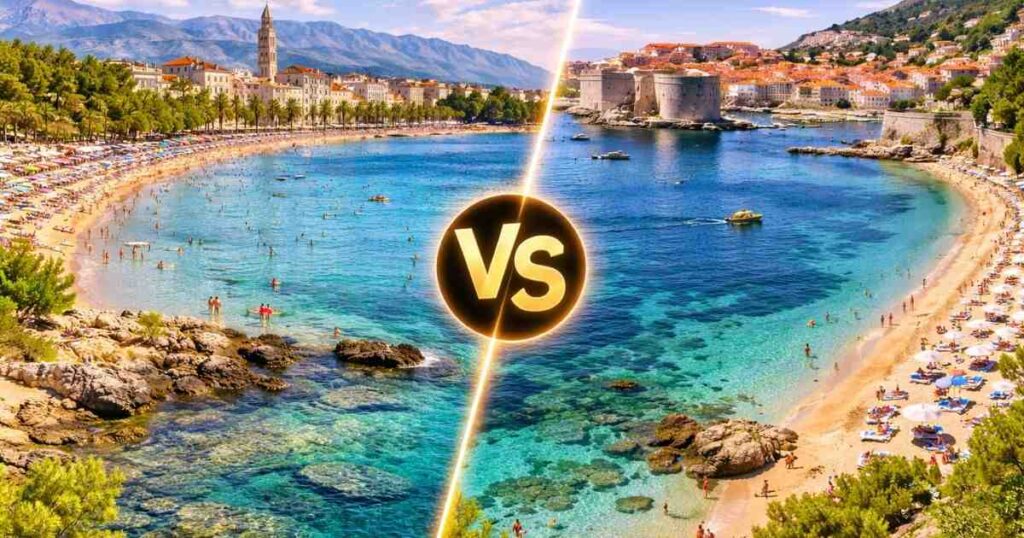
Split’s best beach, Bačvice, sits a 10-minute walk from the main train station. It is a shallow sandy bay famous for picigin, a local ball game played in ankle-deep water that you will not see anywhere else in Croatia. Kaštelet beach on Marjan Hill takes 20 minutes to reach on foot from the palace and offers cleaner water with far fewer people. Dubrovnik has no comparable sandy beach near the old town Banje Beach, the closest option, is 500 meters from the Pile Gate but is largely occupied by a beach club that charges €20 for a sunbed.
Dubrovnik’s better beaches are on the Lapad Peninsula, 4 km from the old town by bus. Copacabana Beach on Lapad has a sandier surface and calmer water but reaching it requires a €1.73 bus ride or a €10 taxi each way. The island of Lokrum, accessible by a 15-minute ferry for €19 return from Dubrovnik’s old port, offers rocky coves and a saltwater lake one of the most underrated swimming spots on the Croatian coast.
For beach access and variety within walking distance of your accommodation, Split has the structural advantage. Dubrovnik’s coastline is dramatic and beautiful but convenience is not its strength.
Pro Tip: At Bačvice in Split, arrive before 9:00 AM in July or August. By 10:30 AM the shallow bay fills completely and the water temperature in August reaches 26° C. Ideally swimming but you will be sharing it with 400 people.
Split vs Dubrovnik: Cost Comparison

Split is consistently cheaper than Dubrovnik by 25–35% across every spending category. A sit-down lunch with a main course and a beer at a konoba (traditional Croatian restaurant) inside Diocletian’s Palace costs €12–€16. The same meal in Dubrovnik’s old town runs €18–€28 at comparable quality restaurants. Accommodation in Split for a private double room in a central guesthouse averages €85–€120 per night in peak July–August. In Dubrovnik, the equivalent room starts at €130 and regularly reaches €200+.
Entry fees tell the same story. Split’s Diocletian’s Palace has no entrance fee you walk in free and explore most of the complex without paying anything. The Cathedral of Saint Domnius (built inside Diocletian’s mausoleum) charges €5 and the baptistery costs €3 separately. Dubrovnik’s city walls cost €35 per adult, the single most expensive standard tourist attraction on the Croatian coast. The Rector’s Palace museum charges €15. A cable car ride to Mount Srđ above Dubrovnik costs €20 return.
A realistic 3-day budget in Split, including accommodation, meals, activities and transport, runs €240–€330 per person. The same 3 days in Dubrovnik costs €330–€450. This gap matters if you are building a longer Croatia itinerary that includes islands or other destinations.
Pro Tip: In Dubrovnik, buy your city walls ticket online 48 hours before your visit. Walk the 1,940-meter circuit starting at 8:00 AM by 10:00 AM the walls carry over 1,000 people simultaneously in peak season and the heat on the exposed stone path becomes oppressive.
Split vs Dubrovnik: Crowds and Seasonality

Dubrovnik’s cruise ship problem is not exaggerated. On peak days in July and August, up to 8,000 cruise passengers disembark and move through an old town designed for a resident population of 1,500. The Croatian government has attempted to cap cruise arrivals but the old town streets, some only 2 meters wide, become functionally impassable between 10:00 AM and 4:00 PM. Split receives cruise ships too but the city’s footprint is large enough that crowds distribute across the waterfront promenade (Riva), the palace and surrounding neighborhoods.
September is the single best month for both cities. Sea temperature stays above 23°C through mid-October, prices drop 20–30% from August peaks, school holidays end across Europe and the cruise ship schedule reduces significantly. May is the second-best window temperatures sit between 18°C and 23°C, accommodation is available at low-season rates and the water is cool but swimmable by late May.
January and February are the quietest months in both cities. Dubrovnik in January is nearly empty, with many restaurants and shops closed. It is a genuine ghost town experience that some travelers seek deliberately. Split in winter has 50,000 residents who keep the city functioning, so restaurants, markets and daily life continue regardless of tourist numbers.
Pro Tip: If your schedule allows only one peak-season visit, Split handles July crowds more comfortably than Dubrovnik. In Dubrovnik, stay in the old town only if your budget allows, otherwise book accommodation in Lapad and take the bus in during early morning hours.
Split vs Dubrovnik: Day Trips and Surrounding Islands
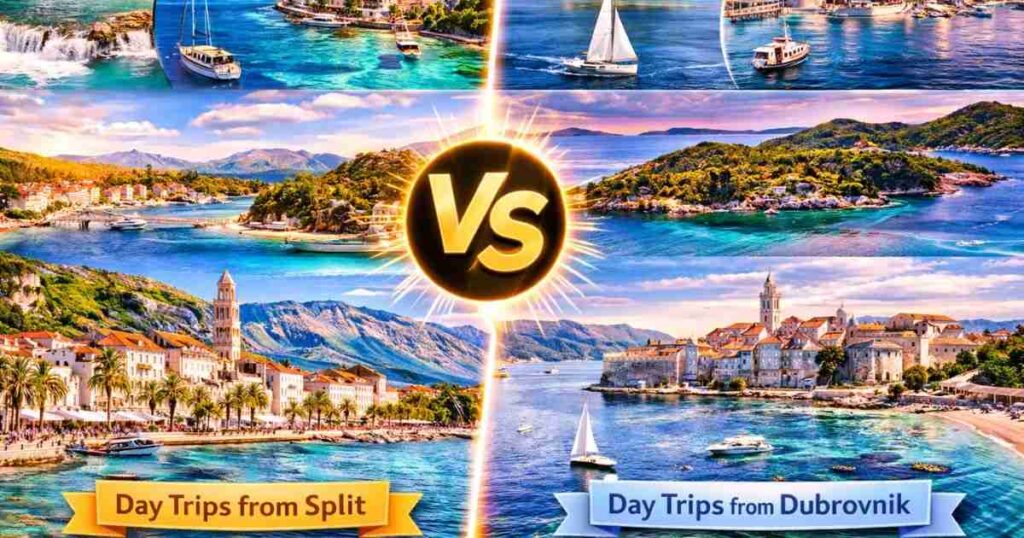
Split sits at the center of the Dalmatian island network in a way Dubrovnik cannot match. Hvar island is 1 hour by catamaran from Split’s ferry terminal (€10–€13 one way). Brač island, home to Zlatni Rat, a beach that actually shifts shape with the current is 50 minutes by car ferry for €6. Vis island, the most remote inhabited island in the Croatian Adriatic, is 2.5 hours by ferry and far less crowded than Hvar. All three islands run multiple daily departures from Split’s central ferry terminal, which sits a 5-minute walk from Diocletian’s Palace.
From Dubrovnik, day trip logistics are more limited. The Elafiti Islands (Šipan, Lopud, Koločep) are accessible by ferry and offer peaceful villages and car-free environments. Lopud takes 50 minutes and a return ticket costs €9. Montenegro’s Bay of Kotor is a popular day trip from Dubrovnik, roughly 2 hours by road. Most Dubrovnik tourists book organized tours for €35–€50 because the self-drive border crossing adds complexity.
Mostar in Bosnia and Herzegovina is 2.5 hours from Dubrovnik by bus (€15–€20 return) and offers one of the most dramatic Ottoman old towns in Europe the Stari Most bridge rebuilt after 1993 and the Blagaj Tekke monastery 12 km outside town make it a full day trip with genuine historical weight.
Pro Tip: From Split, book the Hvar catamaran for the early morning departure (typically 7:30 AM) to arrive before the charter yacht crowd. Return on the last ferry at 8:30 PM to get a full 12-hour day on the island.
You may also like:
Frequently Asked Questions
How many days do you need in Split?
Three days gives you enough time to explore Diocletian’s Palace thoroughly, spend a half-day on Marjan Hill, visit Bačvice beach and take a day trip to Brač or Hvar. Four days allows a second island day trip or a slower pace across the city’s museums and waterfront. One day is not enough. The palace alone requires 3–4 hours to explore properly and rushing through Split means missing the upper town districts outside the palace walls.
Is Split worth visiting?
Split is one of the most historically dense cities on the Mediterranean, a Roman imperial palace that became a medieval city that became a modern Croatian port. Unlike purpose-built tourist destinations, Split has a resident population of 167,000 people who use the old town daily. The combination of accessible beaches, island connections, Roman history and a lower price point than Dubrovnik makes Split a stronger overall value destination on the Dalmatian coast.
What is the best time to visit Split vs Dubrovnik?
September is the best month for both cities with warm sea temperatures, reduced crowds and lower accommodation prices compared to July–August peaks. For Split, May also works well because the city functions normally regardless of season. For Dubrovnik, avoid July and August if you are sensitive to overcrowding the old town becomes genuinely uncomfortable during peak cruise hours. October is underrated for both cities average temperatures of 18–20°C, quiet streets and the olive harvest in surrounding villages.
Is Dubrovnik expensive for tourists?
Dubrovnik is one of the most expensive cities in Croatia. A standard lunch in the old town costs €18–€28 per person, the city walls entry fee is €35 and a double room in a central location runs €130–€200+ in peak season. Budget travelers can reduce costs by staying in Lapad (4 km from the old town) where accommodation runs €70–€100 per night, cooking some meals and prioritizing free or low-cost attractions like the Franciscan Monastery cloister (€5 entry) over multiple paid museums.
Should you visit both Split and Dubrovnik on the same trip?
Yes the two cities complement each other well and the journey between them is part of the experience. The 4.5-hour ferry from Split to Hvar to Korčula to Dubrovnik passes through some of the most dramatic island scenery on the Adriatic. A practical Croatia itinerary runs 3 nights in Split, 2 nights on Hvar and 3 nights in Dubrovnik covering both cities without either feeling rushed. The direct bus from Split to Dubrovnik (€15–€20) takes 4 hours and runs several times daily.
Conclusion
The Split vs Dubrovnik debate does not have a wrong answer, it has a wrong assumption, which is that one replaces the other. Split gives you Roman history embedded in a living city, better beach access, cheaper daily costs and the best island connections on the Croatian coast. Dubrovnik gives you one of Europe’s most architecturally complete medieval cities, dramatic cliff-side sea views and proximity to Montenegro and Bosnia. If your itinerary only allows one stop, choose based on budget and crowd tolerance: Split for value and space, Dubrovnik for visual impact and prestige. Walk Diocletian’s Palace at 7:00 AM before any tour groups arrive, find the Golden Gate on the north side and stand in the peristyle square where 1,700 years of history occupy the same 30 square meters you are standing in that moment alone justifies the trip.

