
Zadar does not try to impress you the way Dubrovnik does. There are no cable cars, no Instagram queues, no entrance fee to walk the main street. What you get instead is a Roman forum that still has its original columns standing, a coastline that literally produces music from the wind and an Old Town where locals still actually live, not just tourists passing through. Most people driving down the Dalmatian Coast treat Zadar as a fuel stop. That is a mistake worth correcting. This guide covers everything you need to know about things to do in Zadar from the waterfront installations to the best nearby beaches, day trips to national parks and the neighborhoods most visitors never find.
In This Guide You Will Find:
- The exact time to arrive at the Sea Organ for the best experience
- Three beaches within 30 minutes of the Old Town that locals actually use
- How to do Plitvice Lakes and Krka Falls as day trips from Zadar
- Where to eat a full seafood meal for under €20
- One neighborhood most tourists skip entirely
- When Zadar is worth visiting and when to avoid it
Quick Info
| Detail | Info |
| Location | Dalmatian Coast, Croatia |
| Nearest Airport | Zadar Airport (ZAD) 8 km from city center |
| Best Time to Visit | May–June or September–October |
| Travel Time from Split | 1.5 hours by bus |
| Days Recommended | 2–3 days |
| Average Daily Cost | €50–€90 per person |
Things to Do in Zadar: Start With the Old Town
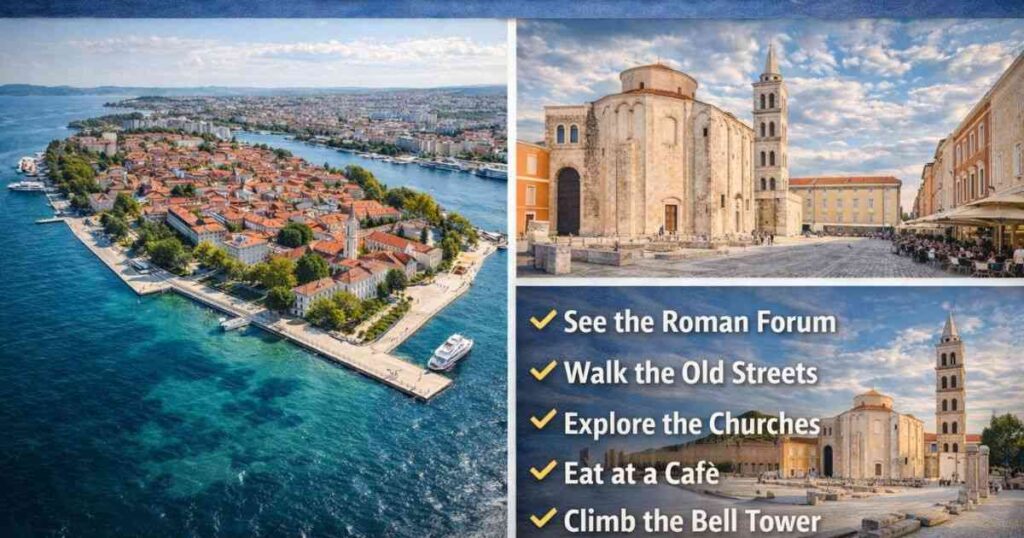
When people ask about things to do in Zadar, the Old Town is always the right starting point and for good reason. The entire peninsula is walkable in 12 minutes from the Land Gate to the Sea Gate but that small size hides an extraordinary density of history. The Roman Forum, built in the 1st century BC, sits in the open air with original stone columns still standing. Right next to it is the Church of St. Donatus, a circular 9th-century church built partly from Forum stone, with entry costing €4. Every August, the church hosts the International Festival of Renaissance Polyphony, a concert series worth planning your trip around.
The Cathedral of St. Anastasia, completed in the 13th century, is one of the finest Romanesque structures on the Adriatic coast. Climb its bell tower for €3 and you get a clear view across the rooftops to the island of Ugljan, 7 km offshore. The main pedestrian street, Kalelarga, runs the length of the Old Town and is lined with café terraces where coffee costs €1.50–€2 roughly half what you pay in Dubrovnik. The Museum of Ancient Glass holds one of Europe’s largest collections of Roman glassware recovered from local archaeological sites, with entry at €5. These are not reconstructions the colored glass vessels on display are 1st to 4th century originals.
Most tourists cover the Forum and the cathedral and consider the Old Town done. The part they miss is the early morning. Walk Kalelarga at 7:00 AM before cruise ship day-trippers arrive and the Forum is yours empty, lit by flat morning light, with only the sound of café chairs being set out around it.
Pro Tip: Enter St. Donatus church on a weekday morning when tour groups are thin. The acoustic inside the circular stone interior is unlike anything else in Croatia worth sitting in silence for five minutes.
The Sea Organ and Sun Salutation
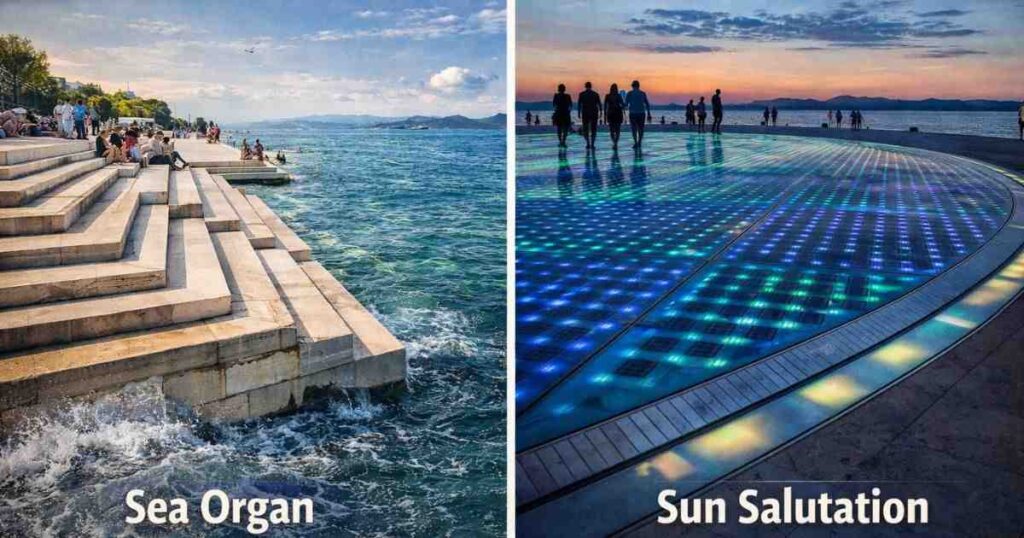
Among all the things to do in Zadar, the Sea Organ is the one that stays with you longest. Installed in 2005 by architect Nikola Bašić, it consists of 35 pipes built beneath marble steps leading into the Adriatic. Wind and wave movement push air through the pipes and produce a constantly shifting chord not a melody, not noise but something between the two that changes with the weather. It costs nothing to sit on the steps and listen. Twenty meters away stands the Sun Salutation, a 22-meter circle of 300 solar glass panels set flush into the pavement. During the day the panels charge from sunlight. After dark they power a color-shifting light display that responds to foot traffic across the circle.
Alfred Hitchcock reportedly called the sunset in Zadar the most beautiful in the world. A plaque near the waterfront marks the claim. Whether or not Hitchcock actually said it, the sunset here does something specific: the limestone pavement turns gold, the sea goes flat and copper-colored and the Sea Organ plays underneath all of it. Most visitors photograph the installations in the afternoon and leave before the best part. The 20 minutes after the sun drops below the horizon when the sky holds orange and pink before going dark is when the Sea Organ’s sound changes character as the evening wind picks up.
Both installations are free and open at all hours. No ticket, no queue, no guided tour required.
Pro Tip: Arrive at the Sea Organ 35–40 minutes before sunset, take a seat on the lower marble steps and stay until the sky is fully dark. The post-sunset window is the moment most people miss.
Beaches Near Zadar Worth the Trip
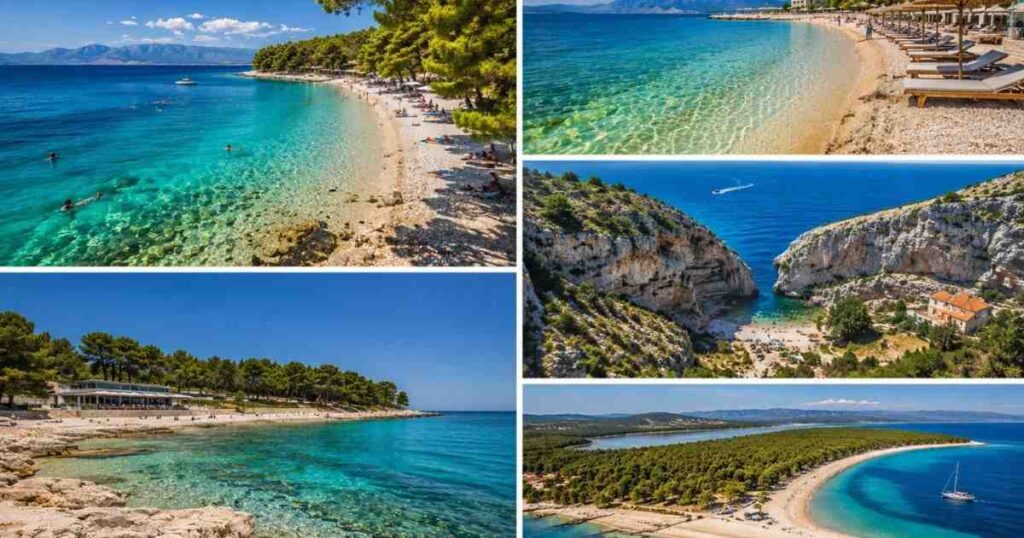
Finding good beaches is one of the most practical things to do in Zadar and the options are better than the Old Town’s rocky shoreline suggests. The peninsula itself has a few sea access points but no real beach. The swimming is close by. Borik Beach sits 10 minutes by car or 30 minutes on foot northwest of the Old Town pebble and rock shoreline, clear water and café bars along the edge. Entry is free, parking costs €2–€3 per hour in July and August and the sea temperature reaches 26°C in peak summer.
Kolovare Beach is the closest option to the Old Town, a 15-minute walk south from the city walls. It’s a pebble beach with sunbed rental at €5 per day, a café and calm water that works well for children. By 11:00 AM in summer it fills up. Go before 9:30 AM or after 5:00 PM. For something genuinely uncrowded, the island of Ugljan is a 25-minute ferry ride from Zadar harbor. The ferry runs roughly every hour in summer and costs €4 each way. Bike rental near the Ugljan ferry dock runs €10 per day and the island’s western coves are accessible by bike along a flat coastal path.
Most visitors to Zadar never cross to Ugljan, which is precisely what makes it worthwhile. The rocky coves on the island’s west side have 10–15 meters of underwater visibility and are full of sea urchins, small fish and the occasional octopus.
Pro Tip: Pack your own snorkeling gear for Ugljan rentals are scarce on the island and the underwater visibility in the western coves makes snorkeling genuinely worth doing.
Day Trips from Zadar to National Parks
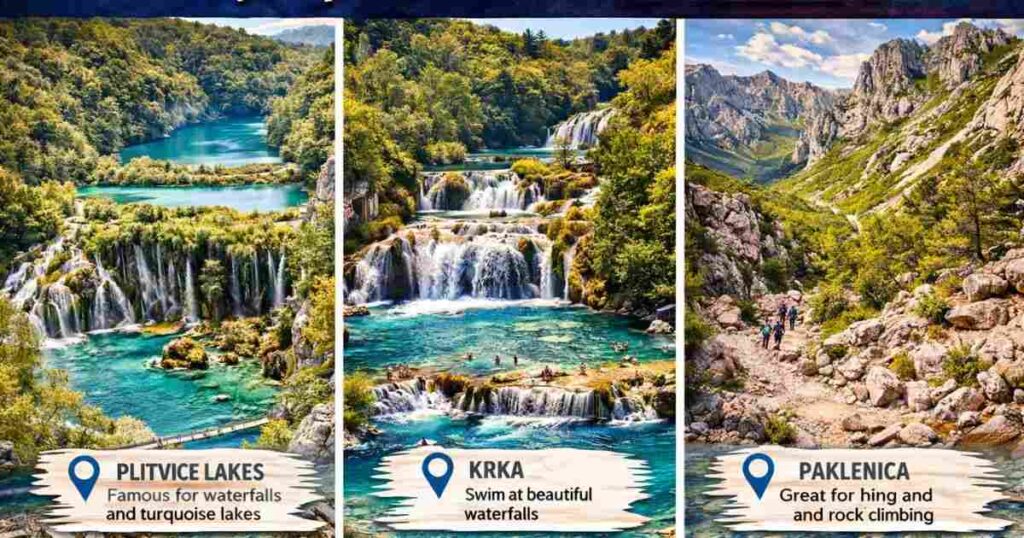
The single best argument for using Zadar as a base is its location and day trips are some of the most valuable things to do in Zadar‘s surrounding region. Plitvice Lakes National Park is 130 km east, reachable in 1 hour 45 minutes by car or 2 hours by organized bus tour. Entry costs €23.50–€39.90 depending on season and route. Tour operators throughout the Old Town sell full day trips for €35–€50 per person, including transport and park entry. The park covers 295 km² of turquoise and green lakes connected by wooden boardwalks and the water color is produced by mineral content and light not a filter.
Krka National Park is 90 km south, about 1 hour 15 minutes by car. Entry runs €8–€30 depending on the season. The main feature is Skradinski Buk, a series of 17 travertine waterfalls over 800 meters of river. Swimming in the falls was banned in 2021 but wading in designated areas is still permitted. Organized day tours from Zadar run €25–€40 and often include a stop in Šibenik, a fortress city worth 90 minutes of your time for its UNESCO-listed Cathedral of St. James alone.
If you have a rental car, the two-day circuit works well: Plitvice on day one with a night in Rastoke village, Krka on day two on the drive back. The total driving distance is approximately 350 km.
Pro Tip: Book Plitvice tickets online at least three days ahead in June, July and August. Walk-up tickets sell out at the gate by 9:00 AM during peak season.
Practical Tips for Getting Around and Eating Well

Knowing the logistics is as important as knowing things to do in Zadar and getting there is straightforward. From Split, the Flixbus takes 1.5 hours and costs €5–€12. From Zagreb, the journey is 3.5 hours and runs €12–€20. The airport sits 8 km from the Old Town: a taxi costs €15–€20 flat, while the shuttle bus charges €5 to the main bus station. The Old Town itself is fully walkable, no car needed unless you’re heading to beaches or national parks independently.
Food costs in Zadar run meaningfully lower than in Dubrovnik or Split’s tourist center. Grilled fish at a konoba, a small, family-run restaurant costs €12–€16 per plate. A full seafood dinner for two with a carafe of local wine comes to €35–€50 at a mid-range Old Town restaurant. Local burek, a flaky pastry filled with cheese or meat, costs €1.50 at any bakery and is more filling than a hotel breakfast. The neighborhood of Voštarnica, just south of the Old Town across the channel bridge, is the part most tourists skip. It’s a local residential area with no major monuments but it has several konobas where a two-course lunch with a drink costs €8–€12. These restaurants serve workers and residents, not tourists, which shows in both the portion sizes and the price.
Zadar in September is significantly better than Zadar in August crowds drop, prices fall 20–30% and the sea temperature holds at 24–25°C, warm enough to swim comfortably through the first week of October.
Pro Tip: Walk from the bus station to the Old Town rather than taking a taxi. It’s 12 minutes, completely flat and passes the Zeleni trg market where local cheese, olives and figs are sold for a fraction of Old Town prices.
You may also like:
Things to Do in Split, Croatia
Frequently Asked Questions
How many days do you need in Zadar?
Two full days cover the main things to do in Zadar comfortably: the Old Town, Sea Organ, Sun Salutation and at least one beach. Add a third day for a national park day trip to Plitvice or Krka. One day gives you the highlights but not the pace the city deserves.
Is Zadar worth visiting?
Zadar is one of the most historically dense cities on the Adriatic coast and significantly less crowded than Dubrovnik or Split. The combination of Roman ruins, medieval architecture, two free waterfront art installations and direct access to two national parks makes it one of the strongest value destinations in Croatia for independent travelers.
What is the best time to visit Zadar?
May and June are the best months, the weather reaches 22–26°C, everything is open and crowds are manageable. September is equally strong: sea temperatures stay swimmable at 24–25°C, prices drop 20–30% compared to August and the city returns to its local rhythm. Avoid the last two weeks of July if busy waterfront areas bother you.
Is Zadar expensive for tourists?
Zadar costs noticeably less than Dubrovnik. A mid-range dinner for two with wine runs €35–€50. A guesthouse in or near the Old Town costs €60–€100 per night. Most major sites cost under €5 to enter and the two most memorable things to do in Zadar, the Sea Organ and Sun Salutation are completely free.
Is Zadar better than Dubrovnik for first-time visitors to Croatia?
For travelers who want history and atmosphere without cruise-ship crowds or inflated prices, Zadar is the stronger choice. Dubrovnik is more visually dramatic and more famous but in peak summer it can feel like a managed tourist site rather than a real city. Zadar is still a city where people live and work and that difference is felt in every meal, every morning walk and every evening at the waterfront.
Conclusion
The best things to do in Zadar are not the ones that require a ticket or a tour. They are the ones that happen when you slow down sitting on marble steps listening to the sea push air through stone pipes, eating grilled fish in a restaurant that doesn’t have an English menu outside, crossing to Ugljan on a ferry with locals who are not on holiday. Zadar rewards travelers who give it time and punishes those who treat it as a stopover. Two or three days here, positioned right on the Dalmatian Coast with Plitvice to the east and Krka to the south, is one of the most efficient and honest ways to experience Croatia. When you arrive, skip the restaurant on your first night. Buy burek from the bakery on Kalelarga, walk to the Sea Organ steps and stay there until the sky goes completely dark.

