
Sedona does not look like a place that belongs to this world. The red rock formations rise 1,000 feet above the desert floor, glowing orange at sunrise and deep crimson at dusk and the silence between those canyon walls carries a weight you feel in your chest before you even step out of your car. Most tourists drive through for a quick photograph and leave within two hours. The ones who stay discover why the spiritual places in Sedona have been drawing seekers, healers and curious travelers from every continent for decades. This guide covers exactly where to go, how long to spend at each site, what each vortex actually feels like and what most first-time visitors completely miss.
In This Guide You Will Find:
- The 4 confirmed vortex sites among the spiritual places in Sedona and how each one feels physically different
- Exact trailhead parking locations and entry fees for every sacred site
- The one hidden spot at Boynton Canyon that most visitors walk right past
- Best months to visit for the quietest, most focused spiritual experience
- How the Sedona spiritual site compare to similar sacred destinations like Maui’s Haleakalā
Quick Info
| Detail | Info |
| Location | Sedona, Yavapai County, Arizona, USA |
| Nearest Airport | Flagstaff Pulliam Airport (FLG) 45 min drive Phoenix Sky Harbor (PHX) 2 hrs |
| Best Time to Visit | March–May and September–November |
| Travel Time from Phoenix | Approximately 1 hr 55 min via AZ-179 N |
| Days Recommended | 3–4 days |
| Average Daily Cost | $120–$200 USD (mid-range traveler, including accommodation, meals, jeep tour) |
Why the Spiritual Places in Sedona Are Unlike Any Other Sacred Destination

Sedona sits at 4,350 feet elevation inside a red rock basin formed from ancient Permian sandstone deposited over 300 million years ago. The Yavapai and Tonto Apache peoples considered this land sacred for over 10,000 years before the first Western settlers arrived in 1876. The U.S. The Forest Service now manages over 1.8 million acres of surrounding Coconino National Forest and most of the Sedona spiritual sites fall within this protected land which means zero commercial development on the sites themselves.
The term “vortex” entered popular use in Sedona in the 1980s but it refers to specific locations where visitors consistently report heightened sensory awareness, emotional release or physical tingling in the hands and feet. Scientists attribute this partly to the high iron oxide content in the red sandstone, the same mineral that makes compasses behave erratically near these formations. Whether you approach the spiritual places in Sedona scientifically or from pure faith, the physical experience of standing on these rocks is real and distinct from standing anywhere else in Arizona.
The four primary vortex sites Airport Mesa, Cathedral Rock, Bell Rock and Boynton Canyon each produce a noticeably different sensation and longtime local guides can describe the difference in precise detail. What separates the Sedona spiritual sites from destinations like Maui’s Haleakalā volcano (entry $35 per car) is raw accessibility. Three of the four vortex sites require only a short hike of 1 to 3 miles round trip. Trailhead parking runs $3 per hour or $15 for a daily Red Rock Pass purchased at any kiosk on site.
Pro Tip: Buy the Red Rock Annual Pass for $40 USD it covers all vortex trailhead parking for 12 months and pays for itself after 3 visits in a single trip.
The 4 Core Spiritual Places in Sedona You Must Visit

Airport Mesa sits at 4,500 feet elevation and rises 1 mile from downtown Sedona on Airport Road. The loop trail runs 3.4 miles and takes about 90 minutes at a moderate walking pace. Among all the spiritual destinations in Arizona, Airport Mesa falls into the upflow vortex category. Visitors consistently report feeling mentally sharp, physically energized and emotionally open here rather than calm or relaxed. Arrive before 7:00 AM to experience it undisturbed by 10:00 AM, pink jeep tour groups fill every viewpoint.
Cathedral Rock is the most photographed formation in Arizona and arguably the most emotionally intense of the spiritual places in Sedona. The trailhead sits at Back O’ Beyond Road off AZ-179 and the hike to the saddle, the actual vortex point, covers 1.5 miles round trip with a short steep scramble over red slickrock near the top. Most visitors turn around 200 feet below the saddle because the rocks look impassable from below. Push through the saddle opens onto a flat platform with 360-degree canyon views and near-complete silence even on busy weekends.
Bell Rock stands 300 feet tall and sits 6 miles south of Sedona on AZ-179 near the Village of Oak Creek. The trail circumnavigates the entire base in 1.5 miles but most spiritual visitors climb the lower flanks no technical gear needed up to about 100 feet and sit directly on the warm rock surface. Unlike the upflow charge of Airport Mesa, the spiritual energy at Bell Rock feels grounding and stabilizing. Visitors who come to the Sedona vortex sites specifically to calm anxiety or mental noise consistently choose Bell Rock over the other three sites.
Boynton Canyon demands the longest approach at 6 miles round trip from the trailhead on Boynton Pass Road. At exactly mile 0.5, an unmarked side trail on the right leads 200 feet uphill to Kachina Woman, a 30-foot red spire that Yavapai oral tradition identifies as a canyon guardian. The overwhelming majority of tourists miss this completely and walk straight to the canyon end. Of all the spiritual destinations in Arizona, Boynton Canyon rewards patience more than any other 20 quiet minutes at Kachina Woman alone justifies the entire drive from Phoenix.
Pro Tip: Visit Bell Rock on Tuesday or Wednesday mornings weekend foot traffic at this site exceeds 400 visitors per day, which destroys the stillness that makes the Sedona spiritual sites worth visiting in the first place.
Hidden Sacred Sites: The Spiritual Places in Sedona Most Visitors Never Find
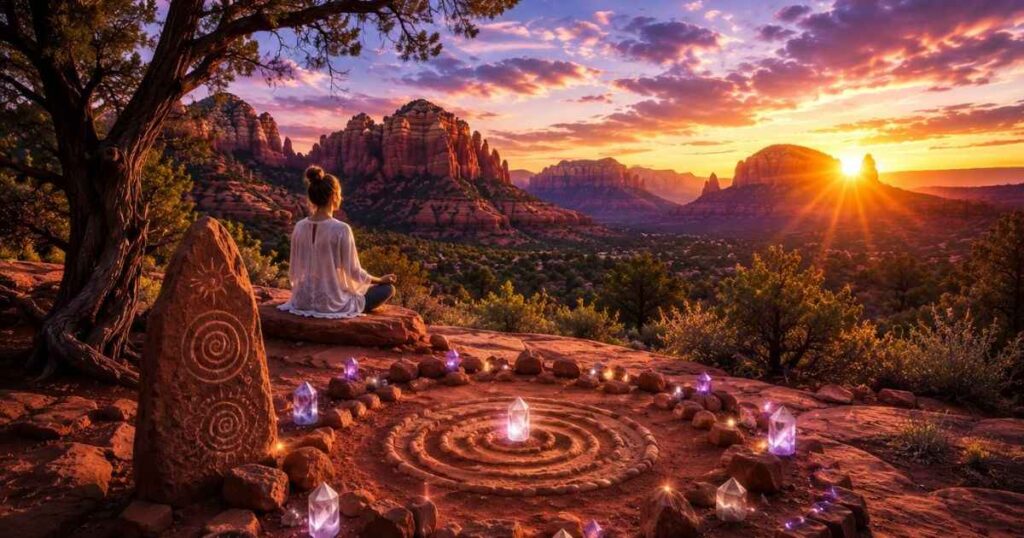
The four vortex sites dominate every travel blog but the spiritual destinations in Arizona extend well beyond them into chapels, stupas and creek-side meditation grounds that most tourists never reach.
Amitabha Stupa & Peace Park on Pueblo Drive is a Tibetan Buddhist stupa built in 2004 on 14 acres of red rock land donated specifically for this purpose. Entry is completely free donation-based and the grounds stay open daily from sunrise to sunset. The circumambulation path around the white stupa takes 20 minutes at a contemplative pace. Among the lesser-known Sedona vortex sites, this site draws both Buddhist practitioners and non-religious visitors seeking silence. The combination of Tibetan sacred architecture set against Sedona’s red canyon walls creates a visual contrast that stops every visitor mid-step.
Chapel of the Holy Cross sits embedded inside the red rock cliffs on Chapel Road, 3 miles from downtown Sedona. Sculptor Marguerite Brunswig Staude commissioned and completed this Roman Catholic chapel in 1956 the building rises 90 feet between two natural rock buttresses. Entry is free, no reservation required and the chapel seats 50 people. The switchback approach road alone prepares your nervous system before you enter. Non-Catholic visitors arrive here in equal numbers to practicing Christians, drawn by architecture that forces silence the moment you step through the door.
Red Rock Crossing sits on Upper Red Rock Loop Road, 4 miles from downtown, where Oak Creek runs shallow across flat sandstone slabs with Cathedral Rock reflected perfectly in the water. This is the location of the most reproduced photograph in Arizona tourism history. Come between October and November when the cottonwood trees along the creek turn deep gold and the water runs at 6–8 inches shallow enough to wade across barefoot. Of all the accessible spiritual places in Sedona, Red Rock Crossing at sunset in October delivers the most concentrated visual impact per square foot of ground.
Pro Tip: The Amitabha Stupa grounds receive almost no visitors before 8:00 AM. Bring a blanket, sit facing east toward the stupa at first light and you will have 14 acres of silent sacred land to yourself, something impossible at the four major vortex sites on any morning of the year.
How to Plan Your Visit to the Spiritual Places in Sedona Without Wasting a Day
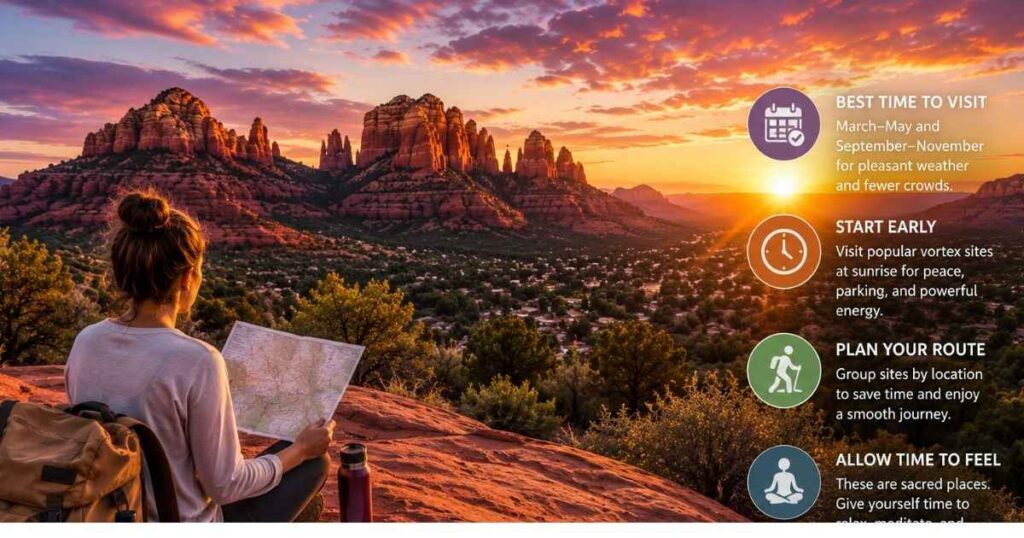
Sedona has no public transit connecting the spiritual places in Sedona to each other or to the town center. You need car standard rentals from Phoenix Sky Harbor run $45–$70 per day. AZ-179, known locally as the Red Rock Scenic Byway, runs north from the Village of Oak Creek directly through Sedona and places you within walking distance of Bell Rock and Cathedral Rock trailheads.
Parking at all vortex sites requires either the Red Rock Pass ($15/day or $40/year) or $3/hour at pay stations. Rangers issue $100 fines with consistent enforcement at every major trailhead seven days a week and do not skip payment. Download the Coconino National Forest Sedona map from the U.S. Forest Service website before you arrive, the cell signal in Boynton Canyon drops to zero inside the first mile of trail.
Guided jeep tours that cover the Sedona vortex sites run $65–$120 per person for 2-hour experiences. Pink Jeep Tours and Arizona Jeep Tours both operate out of downtown Sedona and include a guide who explains both the geological reality and the cultural history of each site. If you prefer walking meditation, private vortex walking sessions run $85–$150 per hour the Sedona Chamber of Commerce website lists vetted local guides under “spiritual experiences.”
March through May brings wildflowers to the canyon floors and temperatures between 55°F and 75°F (13°C–24°C) , the most physically comfortable season for covering multiple Sedona vortex sites in a single day. September and October bring fewer crowds than spring, daytime highs around 78°F (25°C) and the richest afternoon light on the red rocks between 4:00 PM and sunset. July and August bring monsoon storms that flood canyon floors in under 20 minutes to avoid afternoon hiking at Boynton Canyon entirely during those two months.
Pro Tip: Stay in the Village of Oak Creek, 6 miles south of downtown and save $60–$80 per night on accommodation costs. You are 10 minutes by car from Bell Rock and Cathedral Rock, both core Sedona vortex sites, with none of the downtown traffic.
You may also like:
Things to Do in Sedona at Night
Best Hiking Mountains in the World
Frequently Asked Questions
How many days do you need to properly visit the spiritual places in Sedona?
Three full days covers all four vortex sites plus the Chapel of the Holy Cross and Amitabha Stupa with unhurried time at each location. One day allows two vortex sites at most but rushing between the spiritual places in Sedona defeats the entire purpose of coming here. Add a fourth day if you want a guided meditation session or a full 6-mile walk into Boynton Canyon.
Are the spiritual places in Sedona worth visiting?
Yes, Sedona’s vortex sites are among the most physically distinctive sacred landscapes in North America. The combination of 300-million-year-old red sandstone, high-altitude desert silence and 10,000 years of Indigenous sacred history creates an environment that produces measurable changes in how visitors feel within hours of arrival. Even skeptics consistently report that the stillness at Cathedral Rock’s saddle is unlike anything they have experienced at other spiritual destinations.
What is the best time to visit the spiritual places in Sedona?
March through May and September through November offer optimal conditions. October is the single best month, monsoon season ends mid-September, crowds thin sharply after Labor Day, cottonwood trees along Oak Creek turn gold and the low autumn sun hits the red formations at an angle that makes every cliff face glow from inside. Visiting the Sedona vortex sites in peak summer (June–August) means competing with 3 million annual tourists on trails designed for a fraction of that number.
Is Sedona expensive for spiritual travelers?
Mid-range hotels in downtown Sedona run $180–$280 per night motels in the Village of Oak Creek run $90–$130. Sit-down restaurant meals average $18–$30 per person. The spiritual places in Sedona themselves cost only the $15 Red Rock Pass per day. A complete 3-day spiritual trip with accommodation, meals, one guided jeep tour and transport from Phoenix costs $600–$900 total for one person traveling mid-range.
Can you visit the spiritual places in Sedona as a day trip from Phoenix?
Yes but one overnight stay transforms the experience completely. Phoenix to Sedona runs 1 hour 55 minutes each way, leaving roughly 5–6 hours on site if you depart Phoenix by 6:30 AM. That covers Airport Mesa and Cathedral Rock comfortably. You cannot reach Boynton Canyon and return to Phoenix without rushing through the two best spiritual destinations in Sedona. One night in the Village of Oak Creek costs $90–$130 and unlocks dawn access to every vortex site before day-trippers arrive.
Conclusion
The spiritual places in Sedona earn their reputation not through marketing or mythology but through direct, repeatable physical experience that visitors describe with remarkable consistency regardless of belief system. No other destination in the American Southwest packs this density of sacred Indigenous history, geological uniqueness and accessible silence into a 10-mile radius. Book your accommodation in the Village of Oak Creek, set your alarm for 5:45 AM on the first morning and drive straight to Airport Mesa. Stand on that rim as the sun clears the Mogollon Rim to the east and turns the canyon below from cold grey to burning gold. That specific light on that specific rock, in complete silence, is the moment that makes people change their return flights and stay another three days.

