
Sharks and swimmers do not belong together, that is what most people believe until they actually swim with leopard sharks La Jolla for the first time. The leopard sharks at La Jolla Cove are slow, bottom-dwelling and completely indifferent to human presence. Every summer, hundreds of them gather in the warm shallow water just off the cove’s sandy floor and snorkelers float within two feet of them without either side reacting. There is no boat, no cage, no certification and no expensive guided tour required. You walk to the water, put your face in and within 15 minutes the sharks appear below you. This guide gives you everything you need exact timing, gear costs, entry routes, safety rules and what to expect when you are face to face with a 4-foot shark at 12 feet underwater.
In This Guide You Will Find:
- The exact months when leopard shark numbers at La Jolla Cove hit their peak and one month most visitors overlook
- The specific water entry point that cuts your shark search time from 20 minutes to 7 minutes
- Full gear rental costs from a shop that is a 3-minute walk from the cove stairs
- What leopard sharks look like underwater and how close they let you approach before moving away
- Complete cost breakdown: solo DIY visit vs. guided tour and which one is actually worth your money
- One free, no-gear option that most tourists walk right past without realizing what they are missing
| Detail | Info |
| Location | La Jolla Cove, 1100 Coast Blvd, La Jolla, San Diego, CA |
| Nearest Airport | San Diego International (SAN) 14 miles, 20-minute drive |
| Best Time to Visit | July through October peak leopard shark season |
| Travel from Downtown San Diego | 25 min by car / 45 min via Bus Route 30 |
| Days Recommended | 1 full day pair with La Jolla village and clifftop walk |
| Average Daily Cost | $40–$80 per person (gear rental + parking + food) |
Why Swim with Leopard Sharks La Jolla And Nowhere Else in California
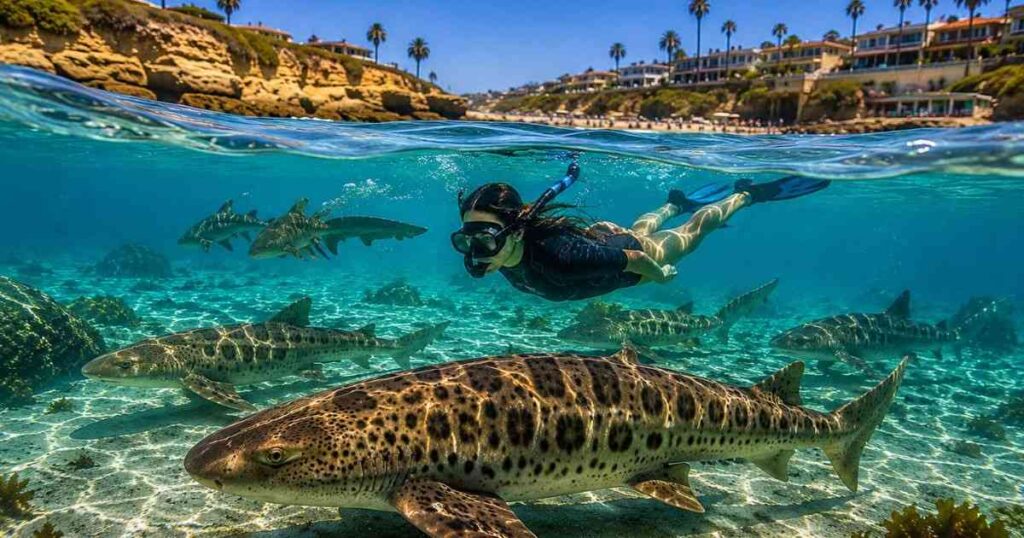
To swim with leopard sharks La Jolla is to understand why this one small cove has become one of the most visited snorkeling destinations on the entire West Coast. The cove sits inside the San Diego–La Jolla Underwater Park Ecological Reserve, a legally protected zone where fishing, collecting and hunting have been banned for decades. That protection means the leopard sharks here face no pressure, feel no threat and have no reason to leave. Other California beaches see occasional leopard sharks. La Jolla Cove gets them in the hundreds, every summer, like clockwork.
The sharks come for two reasons: warm water and food. Between July and October, the cove’s shallow sandy floor heats above 68°F (20°C), which is exactly the thermoregulation range leopard sharks prefer. The sandy flat north of the main beach sitting at just 10 to 15 feet deep is loaded with sand crabs, small fish and buried invertebrates that form the sharks’ primary diet. This specific combination of water temperature, depth and food source does not exist at any other easily accessible California beach.
Leopard sharks grow to between 3 and 5 feet. Their markings are unmistakable dark saddle-shaped blotches across a silvery-brown body, running from head to tail. They move slowly, hugging the seafloor and will cruise within 18 inches of a motionless snorkeler without changing course. In their entire documented history, no leopard shark has ever been confirmed to attack a human swimmer anywhere in the world.
When you compare the chance to swim with leopard sharks La Jolla against other shark encounters, whale sharks in Isla Mujeres at $150 to $200 per person by boat or lemon sharks in the Bahamas requiring full scuba gear the La Jolla experience stands alone in its accessibility. Entry to the water is free. Snorkel gear rents for $25. Parking costs $2.50 per hour. This is the best value wildlife encounter on the West Coast and it is not close.
Pro Tip: The north entry point of La Jolla Cove, a small rocky path to the left of the main beach stairs drops you directly above the sandy flat where sharks gather. Use this entry and you reach the aggregation zone in 7 minutes instead of 20.
When to Swim with Leopard Sharks La Jolla: Month-by-Month Breakdown
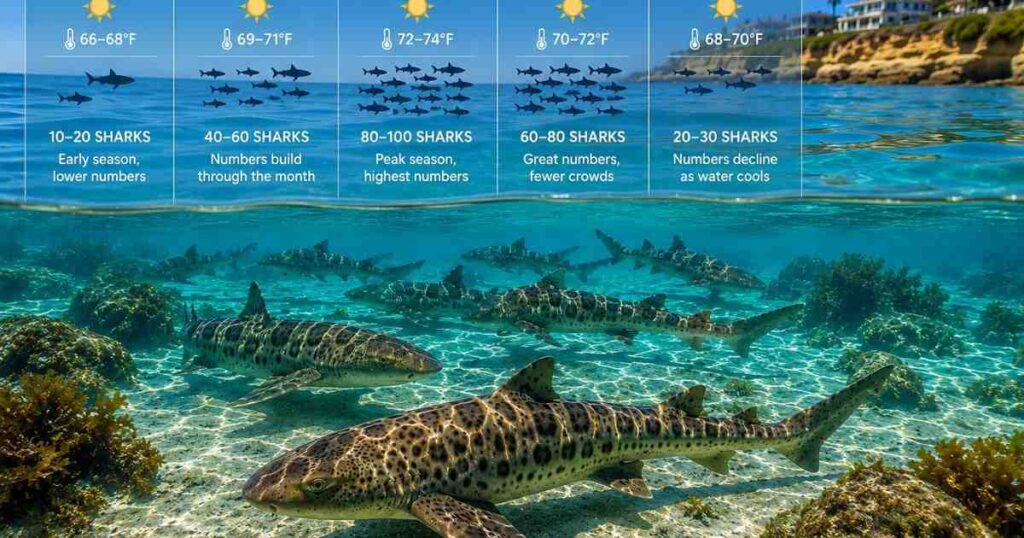
Timing your trip correctly is the single most important decision you will make when planning to swim with leopard sharks La Jolla. Arrive during the right window and you will float above dozens of sharks within minutes. Arrive outside the season and you will find an empty sandy floor.
Late June: The first leopard sharks appear as water temperatures cross 68°F. Numbers are low 10 to 20 sharks on a good day but crowds are also minimal and the experience is peaceful. Good for snorkelers who dislike busy water.
July: Shark numbers build steadily through the month. By late July, the sandy flats reliably hold 40 to 60 sharks on calm mornings. Water temperature averages 69 to 71°F. This is when most California locals plan their annual swim with leopard sharks at La Jolla Cove.
August: Peak season. The aggregation regularly exceeds 80 to 100 sharks on the north sandy flat. Water reaches 72 to 74°F at the surface. This is the best month if maximum shark density is your goal but also the busiest, with weekend mornings seeing 50 or more snorkelers in the water simultaneously.
September: The smartest month to swim with leopard sharks La Jolla if you want the best experience without the crowds. Shark numbers remain strong compared to late July but beach traffic drops sharply after Labor Day. Weekday mornings in early September give you warm water, good visibility and sometimes fewer than 10 other snorkelers in the entire cove.
October: Shark numbers fall progressively as water temperatures drop. Early October still delivers sightings but by mid-month the aggregation has largely dispersed into deeper offshore water. Not worth planning a dedicated trip around after the second week of October.
Morning sessions between 7:00 and 9:30 am are consistently better than afternoon visits. By noon, onshore winds create surface chop that cuts visibility from 20 feet down to 8 or 9 feet. The sharks do not leave but seeing them becomes significantly harder. The 7:30 am arrival is the single most impactful decision you can make beyond choosing the right month.
Pro Tip: Before driving to the cove, check the La Jolla Cove Dive Conditions Facebook group. Local divers post visibility reports every morning, including whether leopard sharks were spotted and in what numbers. One quick check can save you a 45-minute round trip on a bad day.
How to Swim with Leopard Sharks at La Jolla Cove: Gear, Costs and the Exact Route
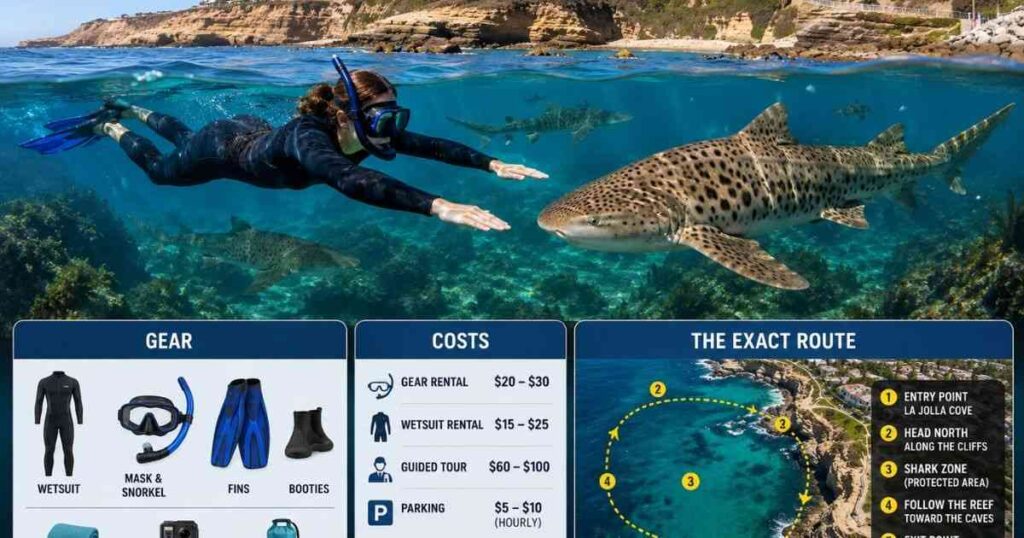
To swim with leopard sharks at La Jolla Cove, you need three things: a mask, a snorkel and fins. No certification, no special training, no guided tour required. Every piece of gear you need is available at La Jolla Cove Snorkel, located at 1221 Coast Boulevard a 3-minute walk from the cove stairs. A full snorkel set (mask, fins, snorkel) rents for $25 per session. A 3mm wetsuit adds $15 and it is worth renting even in August. The water surface may reach 72°F but below 12 feet the temperature drops to around 62°F and without a wetsuit you will get cold and exit the water before the best part of the encounter.
Parking at the lot directly above the cove costs $2.50 per hour. Budget 2 to 2.5 hours for the full experience that covers getting geared up, the snorkel itself and time to walk the clifftop path after. Street parking on Prospect Street is free but gone before 9 am on weekends. Arriving at 7:30 am gets you free parking and the best water conditions simultaneously.
Once in the water, follow this specific route. Enter from the north side of the cove the rocky path left of the main stairs. Swim north along the cliff face for 4 to 5 minutes. Watch the bottom change from rocky reef to open sandy flat at 10 to 12 feet depth. That is the aggregation zone. Float horizontally at the surface with your face down. Do not dive toward the sharks any downward movement causes them to scatter. Passive hovering produces the best encounters: sharks pass directly below you, sometimes within 18 inches, without altering their path.
Everyday California on Prospect Street offers guided tours at $65 per person, including all gear and a guide in the water. For a first-time snorkeler who is nervous about navigation or unsure what to look for, the guide adds genuine value. For anyone who has snorkeled before, the cove is small enough and the route simple enough that the $40 premium over DIY adds nothing.
Pro Tip: Bring a GoPro or rent one with an underwater mount. Smartphone cameras lose color and sharpness below 6 feet due to refraction and light absorption footage shot with a phone looks nothing like what you actually saw. A GoPro Hero mounted to a mask clip captures the experience accurately.
Safety, Marine Reserve Rules and What Most Visitors Completely Miss
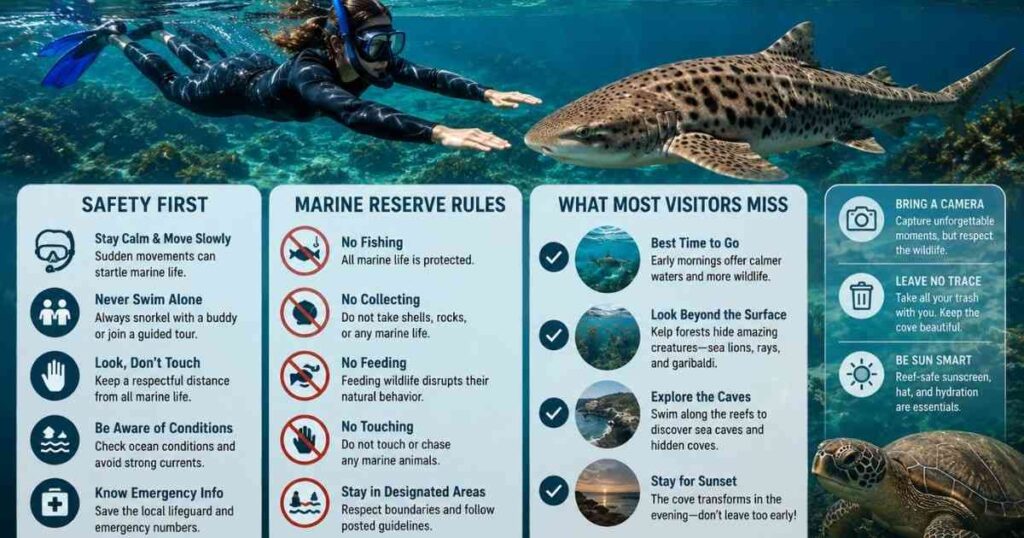
The San Diego–La Jolla Underwater Park is a state-protected ecological reserve. California law prohibits touching, chasing, feeding or disturbing any marine animal inside the reserve boundaries including the leopard sharks. Violations carry fines starting at $500. The rule exists for good reason: touching or diving at a shark causes the nearby aggregation to scatter within minutes, ruining the experience for every other snorkeler in the water. Keep your hands pressed flat against your body at all times.
What most visitors who plan to swim with leopard sharks La Jolla completely miss is the free, no-gear viewing option directly above the cove. The paved clifftop path running along the edge of the bluff gives a direct overhead view of the entire sandy flat where the sharks gather. On calm mornings between 8 and 10 am before surface glare builds you can see individual leopard sharks clearly from 20 feet above the water without entering the cove at all. Families with young children, visitors with limited mobility and anyone who wants to scout conditions before gearing up should spend 10 minutes at the overlook first.
Water visibility changes dramatically depending on conditions. After storms, during red tide or when southerly swells push kelp debris into the cove, visibility can drop from a clear 20 feet to under 5 feet. The sharks are still present but invisible. This is the most common cause of disappointment among visitors who travel specifically to swim with leopard sharks at La Jolla. Always check conditions before you leave the house.
The leopard sharks themselves pose no danger. They feed on sand crabs and small buried fish prey that has nothing to do with humans. Their mouths are positioned on the underside of their snout, angled downward toward the seafloor. Even physical contact, which is both illegal and discouraged, would not result in a bite from this species.
Pro Tip: After your snorkel, stop at Brockton Villa Restaurant at 1235 Coast Boulevard 2 minutes on foot from the cove. Their outdoor patio faces directly over the water, breakfast runs until noon and the Coast Toast ($16) is the local order. You can watch other snorkelers from your table while you eat.
You may also like:
Frequently Asked Questions
Is it safe to swim with leopard sharks La Jolla?
Yes, swimming with leopard sharks in La Jolla is considered safe for all ages and experience levels. Leopard sharks have no confirmed attack on a human swimmer in their entire documented history. The sharks at La Jolla Cove are accustomed to human presence and show no aggression toward snorkelers who float passively above them. The only real hazard at the cove is the rocky entry point, which can be slippery during elevated swell rubber-soled water shoes eliminate that risk entirely.
Do you need experience to swim with leopard sharks at La Jolla Cove?
No prior experience is required to swim with leopard sharks at La Jolla basic snorkeling is all you need and the gear is available to rent 3 minutes from the water for $25. The sharks concentrate between 10 and 20 feet depth, well within snorkel range for a complete beginner. First-time snorkelers who want in-water guidance can book a tour through Everyday California for $65 per person, which includes full equipment and a guide who shows you exactly where the sharks are.
What is the best time of year to swim with leopard sharks La Jolla?
The best time to swim with leopard sharks La Jolla is July through October, with August delivering the highest shark density aggregations of 80 to 100 sharks on the north sandy flat are common during peak weeks. September offers nearly equal shark numbers with significantly smaller crowds, making it the best overall month for most visitors. Morning sessions between 7 and 9:30 am consistently outperform afternoon visits due to better water clarity before wind creates surface chop.
How much does it cost to swim with leopard sharks at La Jolla?
Swimming with leopard sharks at La Jolla Cove costs almost nothing at its most basic level the water is free to enter. Snorkel gear rental runs $25, a wetsuit adds $15 and parking costs $2.50 per hour in the lot above the cove. A full guided tour through Everyday California costs $65 per person including all equipment. Most DIY visitors spend $40 to $55 total, covering parking, gear and a post-snorkel meal at a nearby restaurant.
Is La Jolla better than Catalina Island for swimming with leopard sharks?
For most visitors, La Jolla is the better choice to swim with leopard sharks compared to Catalina Island. Catalina does have leopard sharks year-round but in much smaller numbers and getting there requires a $75 round-trip ferry from Long Beach plus gear rental on arrival. La Jolla requires only a short drive or a $2.50 bus fare and during peak season (July through October) the shark density at La Jolla Cove far exceeds anything Catalina typically produces. Catalina offers richer overall dive variety but if leopard sharks are the goal, La Jolla wins every time.
Final Thoughts
There are very few wildlife encounters in North America that are this accessible, this affordable and this genuinely impressive. To swim with leopard sharks La Jolla, you need $40, one free morning and the willingness to put your face in the Pacific Ocean. The sharks will be there calm, patterned and completely unbothered by your presence. No boat required. No certification. No expensive operator taking 40 percent of the experience away in logistics. Plan your visit for a Tuesday morning in August or early September, arrive at the cove by 7:15 am, enter from the north side and spend your first five minutes just floating above the sandy flat without moving. When a 4-foot leopard shark glides directly beneath your mask unhurried, ancient, indifferent you will understand exactly why people come back to swim with leopard sharks at La Jolla year after year.

