
Most people picture McWay Falls Big Sur as a roaring, hikeable waterfall. It isn’t. You never touch the water, you never reach the beach and the entire visit takes less time than a coffee break. What you get instead is one single, framed view that has become the most photographed spot on the entire California coastline. This guide tells you exactly how to reach that view, what it costs and how to avoid standing in a crowd of fifty people with the same shot on their phone.
In This Guide You Will Find:
- The exact parking fee and where to park for free instead
- How long the walk to the overlook actually takes
- Why you can never reach the beach at McWay Falls Big Sur and what happens if you try
- The best time of day and time of year for photos without fog or crowds
- A nearby trail most visitors never notice
- Honest advice on whether McWay Falls Big Sur is worth the stop on a Highway 1 road trip
Quick Info
| Category | Detail |
| Location | Julia Pfeiffer Burns State Park, Highway 1, Big Sur, California |
| Nearest Airport | Monterey Regional Airport, roughly 45 miles / 60–75 minutes north |
| Best Time to Visit | Late April to June or October, for clear skies and thin crowds |
| Travel Time from Nearest City | About 35–40 minutes south of Carmel-by-the-Sea on Highway 1 |
| Days Recommended | Half a day or a full day if combined with other Big Sur stops |
| Average Daily Cost | $10 parking fee plus $20–$40 for food if you eat nearby |
Getting to McWay Falls Big Sur
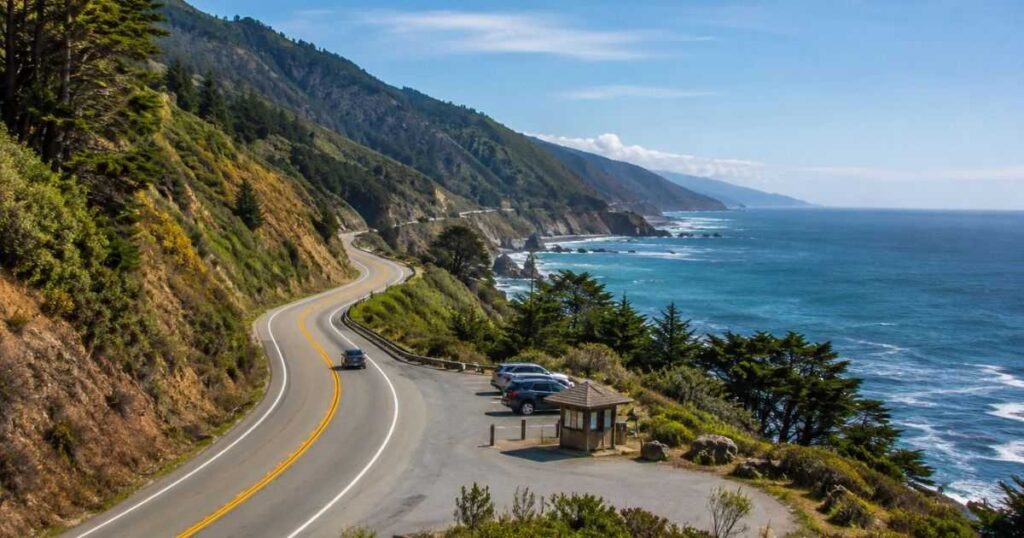
McWay Falls Big Sur sits inside Julia Pfeiffer Burns State Park, about 35 to 40 minutes south of Carmel-by-the-Sea and roughly 12 miles south of Pfeiffer Big Sur State Park on Highway 1. The park entrance is marked and easy to spot from the road, with a small kiosk on the east side of the highway. From San Francisco, the drive to McWay Falls Big Sur takes close to 3.5 hours if you stick to Highway 1 the whole way, longer if you stop at Bixby Bridge or Pfeiffer Beach along the route.
Parking is the first decision you make. The state park lot charges a $10 day-use fee, paid in cash at a self-service station when no attendant is on duty. That fee covers same-day entry to most other Big Sur state parks, so hold on to your receipt if you plan to stop at Pfeiffer Big Sur State Park or Limekiln the same day. If you’d rather skip the fee, you can park for free along the shoulder of Highway 1 just south of the entrance and walk in, though spots fill fast on weekends and holidays. Cell service is unreliable in this stretch of Big Sur, so download directions and any maps before you arrive.
The lot inside the park is small and best suited to standard cars, since anything longer than about 22 feet has a hard time maneuvering the turns. RV and larger vehicle drivers should plan on the free roadside option instead. Traffic on Highway 1 near the park entrance can back up during peak summer afternoons, since the road narrows to a single lane in each direction and drivers slow down for the view before they’ve even parked.
Pro Tip: Arrive before 9 a.m. or after 4 p.m. the free roadside spots near McWay Falls Big Sur fill within minutes of the paid lot reaching capacity.
The Trail and the View at McWay Falls Big Sur
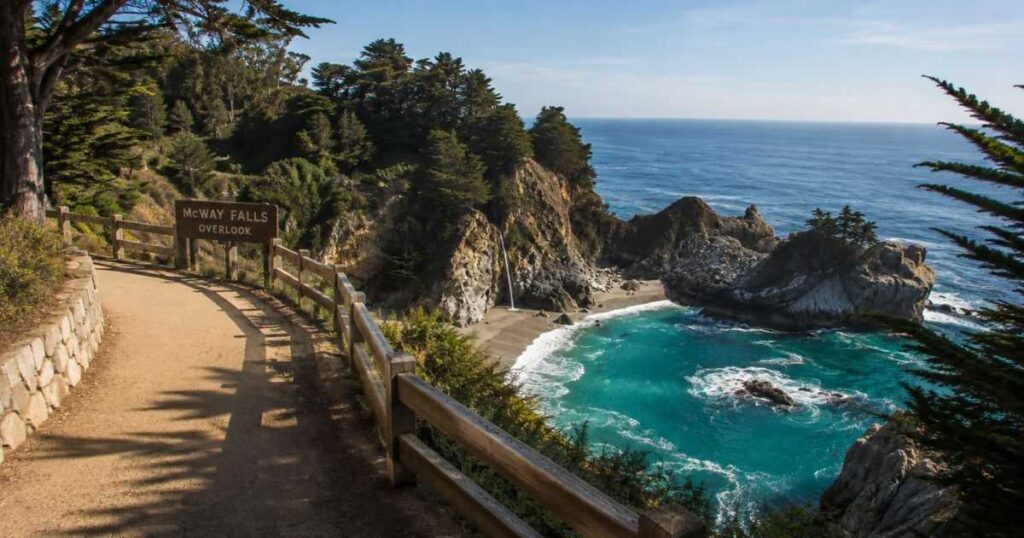
The walk to the McWay Falls overlook covers about 0.5 to 0.6 miles round trip and most visitors finish it in under 20 minutes, including photo stops. The trail is flat, wide and wheelchair accessible, running from the parking area through a short tunnel beneath Highway 1 before opening onto the cliffside viewpoint. From there, McWay Creek drops 80 feet over a granite ledge, landing either on the sand of McWay Cove or straight into the Pacific, depending on the tide.
McWay Falls Big Sur is one of only two waterfalls in California that fall directly onto a beach, which is exactly why it looks unlike anything else on this coast. What most tourists miss is that there is no legal way down to that beach. The cliffs and the cove sit behind a fence and California State Parks treats any attempt to climb down as a citable offense, partly because the terrain has caused serious rescues in the past. The photo you see online is the only version of McWay Falls Big Sur you’re allowed to experience in person.
Verdict: The short trail and single viewpoint make McWay Falls Big Sur one of the easiest stops on Highway 1 but don’t expect a hike it’s a five-minute scenic overlook not a waterfall trek.
The Story Behind McWay Falls Big Sur
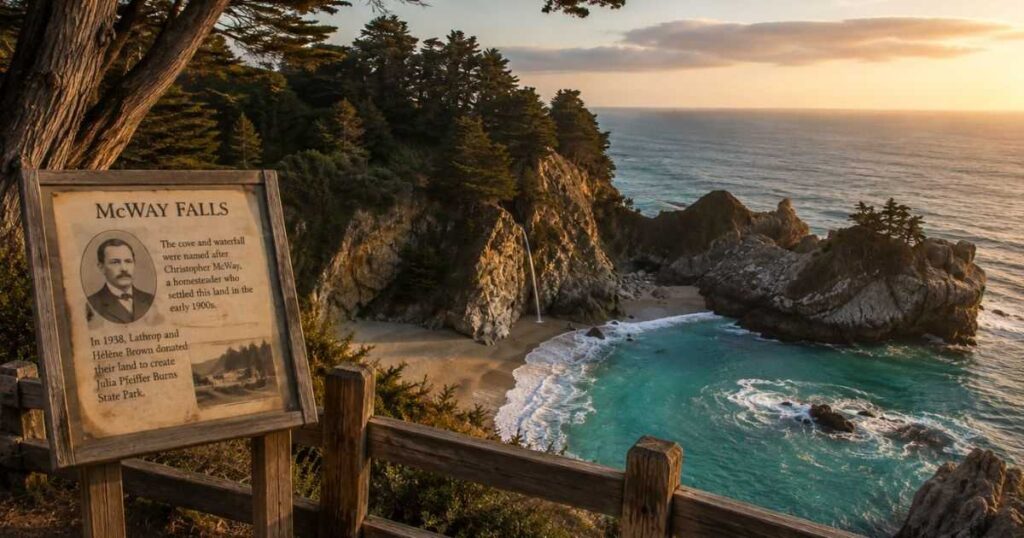
The waterfall and the cove take their name from Christopher McWay, a homesteader who settled this stretch of coast in the early 1900s. Decades later, Lathrop and Hélène Brown, friends of the McWay family, built a home on the bluff directly above the cove and named it Waterfall House. You can still see the stone foundation and a few concrete steps near the overlook, the only physical trace left of that home today.
The surrounding park carries a different name entirely. It’s named for Julia Pfeiffer Burns, a rancher and one of Big Sur’s earliest pioneers, who lived from 1868 to 1928 and spent most of her life working this land before the state established the park in 1962. Locals still occasionally call the falls by an older, informal name but McWay Falls Big Sur is the one that appears on every park sign, map and trailhead marker today.
Understanding this history explains a detail that confuses first-time visitors: why a clearly man-made staircase and foundation sit right beside a completely wild waterfall. It’s a remnant of a private home not a park structure and it’s one more reason this particular overlook feels different from a typical roadside waterfall stop.
Pro Tip: Look for the low stone wall and steps just past the main viewing area that’s the actual foundation of the old Waterfall House and most visitors walk right past it without noticing.
When to Visit McWay Falls Big Sur for the Best Photos
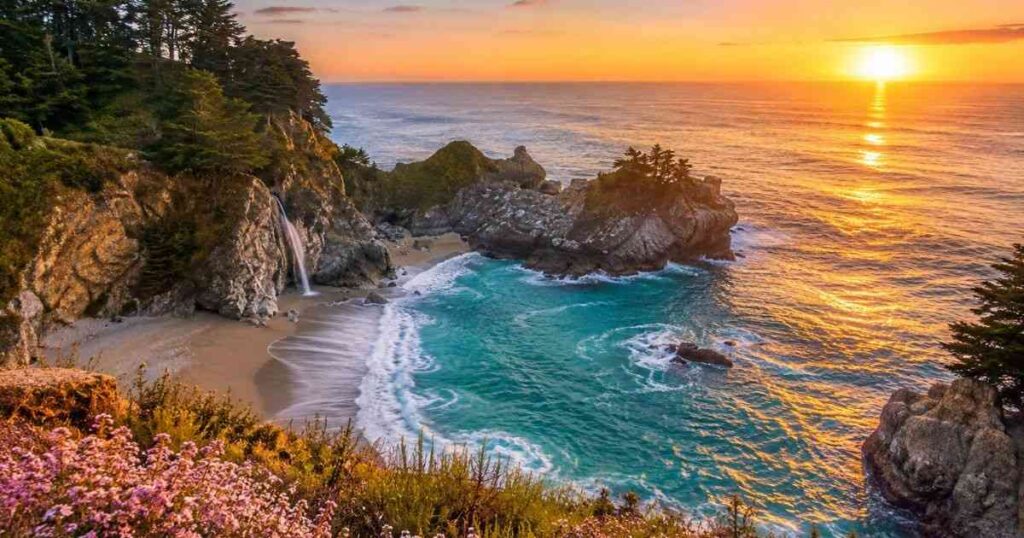
Big Sur fog rolls in most mornings and can sit over the coastline until midday, so afternoon light between 1 p.m and 4 p.m usually gives the clearest view of McWay Falls Big Sur and the turquoise water below it. Late spring, particularly May and June, tends to bring longer stretches of sun before the fog thickens again in midsummer. October is the other reliable window, with warmer inland temperatures pulling the coastal fog back and leaving crisp afternoons.
Winter has its own reward. Migrating gray whales pass close to this stretch of coast between December and April and the trailside benches near the McWay Falls overlook double as a whale-watching spot on clear days. Rain is heaviest from November through March and heavy storms have triggered trail closures here before, so checking current park conditions before a winter visit is worth the two minutes it takes.
Compare this to Pfeiffer Beach, 12 miles north, which trades the waterfall view for purple-tinted sand and a much longer, steeper access road. If you only have time for one coastal stop in Big Sur, McWay Falls Big Sur takes less effort and rewards you faster.
Pro Tip: Check the sun’s position before you go to the overlook faces roughly southwest, so shooting in early afternoon avoids harsh backlighting on the falls.
Practical Tips for Visiting McWay Falls Big Sur
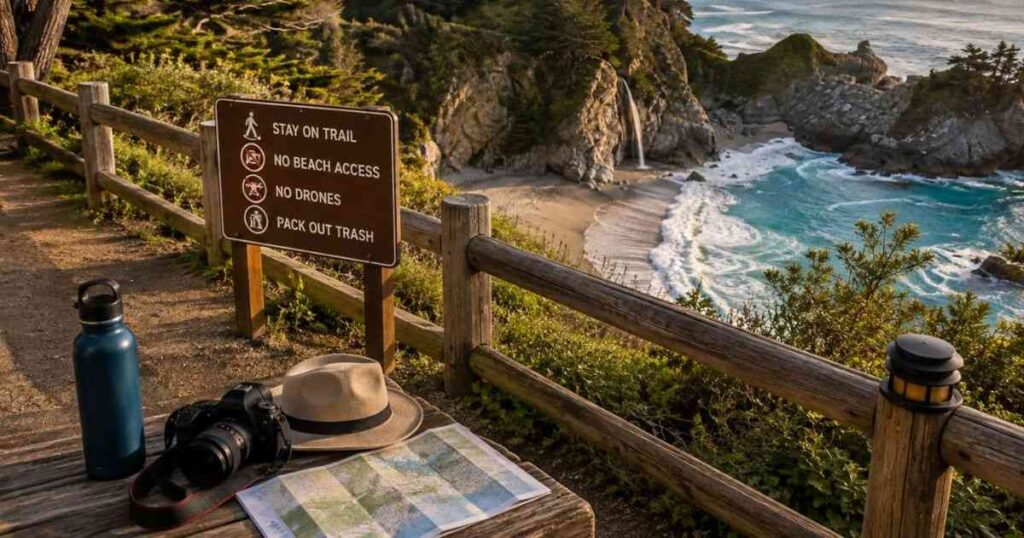
Bring layers no matter the season. Coastal temperatures at McWay Falls Big Sur typically run 10 to 15 degrees cooler than inland Big Sur and wind off the Pacific cuts through light jackets fast. There are no food vendors inside the park, so pack water and snacks or plan to eat at Big Sur River Inn or Nepenthe, both roughly 20 minutes north on Highway 1, where a casual lunch runs $20 to $35 per person.
Restrooms are available near the parking area but there’s no potable water fountain, so fill bottles before you leave Carmel or Monterey. If you want more than the overlook, the Ewoldsen Trail starts from the same park and climbs inland through redwoods along McWay Creek for close to 5 miles round trip, a route that almost every McWay Falls Big Sur day-tripper skips entirely. It adds two to three hours but trades the crowded viewpoint for a quiet, shaded forest walk with almost no other hikers.
Weekends between May and September bring the heaviest crowds, sometimes with a 15-to-20-minute wait just to park. Weekday mornings, even in peak season, rarely have more than a handful of cars.
Trail conditions here can change without much warning. Erosion along the cliffside has closed sections of the overlook trail in the past, so it’s worth checking the California State Parks website the morning of your visit rather than assuming full access. Even during a partial closure, there’s usually still a viewpoint open somewhere along the fence line that keeps the falls in sight.
Pro Tip: Visit on a Tuesday or Wednesday morning if your schedule allows weekday traffic on this stretch of Highway 1 is a fraction of weekend volume.
You may also like:
Pacific Coast Highway Road Trip
Things to Do in Carmel-by-the-Sea
Frequently Asked Questions
How many days do you need for McWay Falls Big Sur?
You only need 20 to 30 minutes at McWay Falls Big Sur itself, since the overlook trail is short and there’s no beach access. Most visitors fold it into a longer Big Sur day trip alongside stops like Bixby Bridge, Pfeiffer Beach or Nepenthe.
Is McWay Falls Big Sur worth visiting?
Yes, it’s one of the most distinctive waterfall views in the United States, since it’s one of only two in California that drop directly onto a beach. The low effort required, a 20-minute round-trip walk, makes it one of the highest-value stops on the entire Big Sur coastline.
What is the best time to visit McWay Falls Big Sur?
Late spring (May–June) and October offer the clearest skies with the least fog and early afternoon light works best for photos of the falls. Winter visits add a chance to spot migrating gray whales from the same overlook.
Is McWay Falls Big Sur expensive for tourists?
No. The state park charges only a $10 day-use parking fee per car and free roadside parking is available just outside the entrance. Food is the main added cost if you eat at a nearby restaurant instead of packing your own.
Can you do a day trip from Monterey to McWay Falls Big Sur?
Yes, easily. McWay Falls Big Sur sits about 45 miles south of Monterey, roughly a 60-to-75-minute drive down Highway 1, making it a comfortable half-day round trip with time left for other Big Sur stops.
Final Thoughts
McWay Falls Big Sur earns its reputation not because it’s hard to reach but because nowhere else on the California coast gives you a waterfall, a hidden cove and the open Pacific in one framed view. You won’t hike for hours or wade in the water and that’s the point: it’s a five-minute payoff after a short walk through a tunnel under Highway 1. Time your visit for early afternoon, skip the crowded weekend slots if you can and stand at the trailside railing until the fog clears enough to see the full curve of McWay Cove below the falls.

