
The waterfall you came to see is real but so is the crowd of 4,000 people who show up after 10 AM to see it with you. Skradinski Buk drops 45.7 meters through 17 travertine steps into pools so green they look filtered and the boardwalk puts you close enough to feel the spray on your face. Krka National Park sits 88 km north of Split and the split to Krka national park day trip is one of the most popular excursions on the Dalmatian coast for a reason you get world-class waterfall scenery within 80 minutes of leaving the city.
But most visitors make the same three mistakes: they arrive too late, they buy tickets at the gate and they skip half of the park that has no queues at all. This guide fixes all three.
In This Guide You Will Find:
- Every transport option from Split to Krka with exact current costs
- The difference between Lozovac and Skradin entry points and which one to choose
- Current entrance fee breakdown and what the ticket actually covers
- The exact months that give you the best waterfalls with the smallest crowds
- What 90% of day-trippers from Split completely miss inside the park
- Practical packing list, food options and parking reality in peak season
Quick Info
| Detail | Info |
| Location | Šibenik-Knin County, Dalmatia, Croatia |
| Nearest Airport | Split Airport (SPU) 70 km from Krka |
| Best Time to Visit | May, June, September |
| Travel Time from Split | 1 hr 20 min by car / 2–2.5 hrs by bus |
| Days Recommended | 1 full day (2 days to see everything) |
| Average Daily Cost | €40–€65 per person |
How to Get from Split to Krka National Park
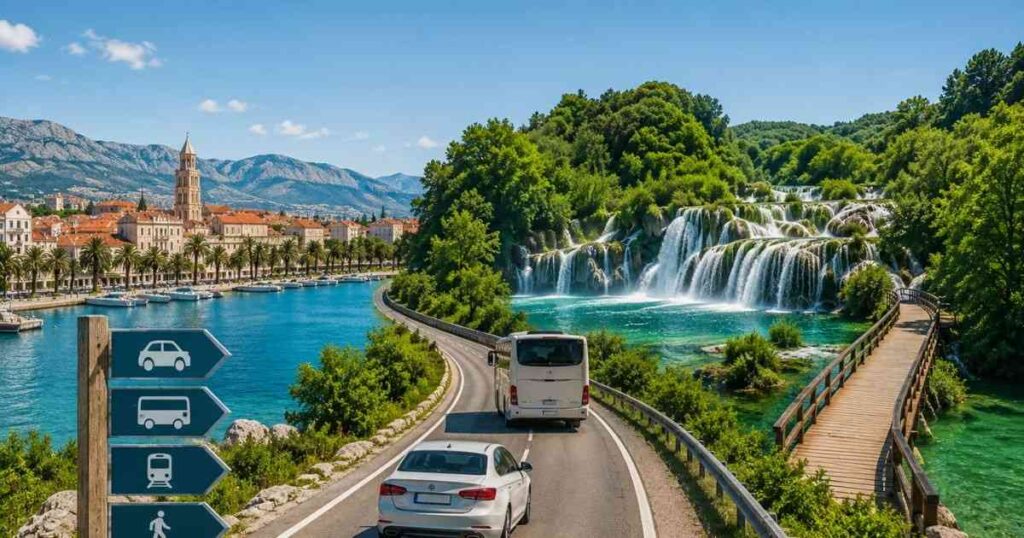
The split to Krka national park route by car takes 1 hour 20 minutes via the A1 motorway northbound. You drive 88 km, exit at Šibenik and follow signs to Lozovac the upper entrance used by most self-driving visitors. Toll fees on the A1 run €4–€5 each way depending on your vehicle class. Renting a car in Split for a single day costs €30–€50 in shoulder season and gives you complete freedom over your arrival time, which matters more here than at almost any other Croatian park.
Public buses from Split bus station to Šibenik depart every 30–60 minutes and cost €6–€8 one way. The ride takes about 55 minutes. From Šibenik, a local bus or taxi to the Lozovac entrance adds another €5–€10 and 25 minutes. Total journey time each way by public transport runs 2 to 2.5 hours, which means you need to leave Split by 6:30 AM to get full value from the day.
Organized tours from Split to Krka National Park cost €35–€55 per person and bundle return transport, park entry and a guide. The catch is that most tours arrive at the park between 9 and 10 AM exactly when the Skradinski Buk boardwalk starts filling up. A shared shuttle transfer, as opposed to a full tour, sometimes offers 7:30 AM departures and costs €15–€20 one way. That earlier start changes your experience completely.
For two people traveling together, a car rental almost always beats the organized tour on price per head. For solo travelers, a shared shuttle or bus-taxi combination is the most cost-effective option at €15–€18 total one way.
Pro Tip: Book any transport from Split at least 48 hours ahead in July and August. Shuttle seats and tour spots sell out by the evening before, especially on weekends.
Entry Points, Tickets and What Your Fee Covers
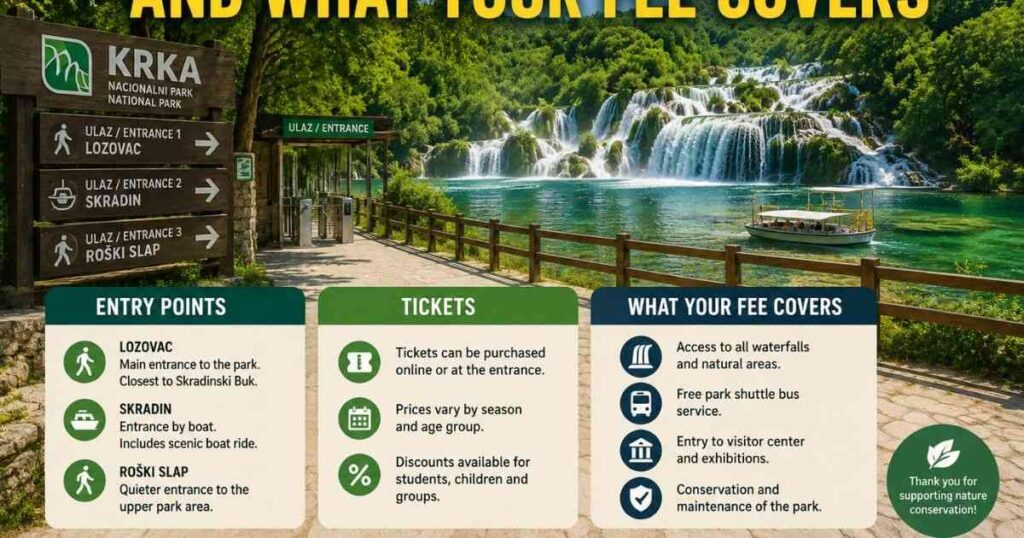
Every visitor doing the split to Krka national park day trip faces the same first decision: enter from Lozovac at the top or Skradin at the bottom. They lead to the same waterfall but via completely different approaches and choosing wrong costs you time.
Lozovac is the upper entrance directly off the A1 motorway. You park, pay entry and take a free shuttle bus 10 minutes down into the canyon. It is faster, more convenient and better suited to self-drive visitors. The parking fee is €3–€5 and the shuttle runs continuously from park opening until one hour before closing.
Skradin sits at the base of the canyon, 4 km from Lozovac by road. From Skradin, a 25-minute boat ride takes you up the Krka River through 80-meter limestone canyon walls to the Skradinski Buk trail. The boat is included in your ticket price if you enter via Skradin. This route is visually outstanding the canyon narrows, the water shifts from deep teal to pale green and you arrive at the falls from a direction that most visitors never see. If you have time for only one route, take the boat one way and the shuttle the other.
Entrance fees in peak season (July–August) are €30 for adults. From May through June and in September, the fee drops to €20. Off-season from November through March, tickets cost €10. Children under 7 enter free. These prices include the shuttle or boat but do not cover Visovac Island excursions (€15 extra) or Roški Slap boat trips (€10–€15 extra).
Buy tickets online at np-krka.hr before you travel. Ticket windows in summer have 20–40 minute queues that eat directly into your best morning hours.
Pro Tip: If you enter via Skradin and want to exit via Lozovac to return to your car, the shuttle runs both ways. Ask the boat staff at Skradin when you board they will explain the return logistics so you do not end up stranded at the wrong exit point.
Best Time to Visit Krka on a Day Trip from Split
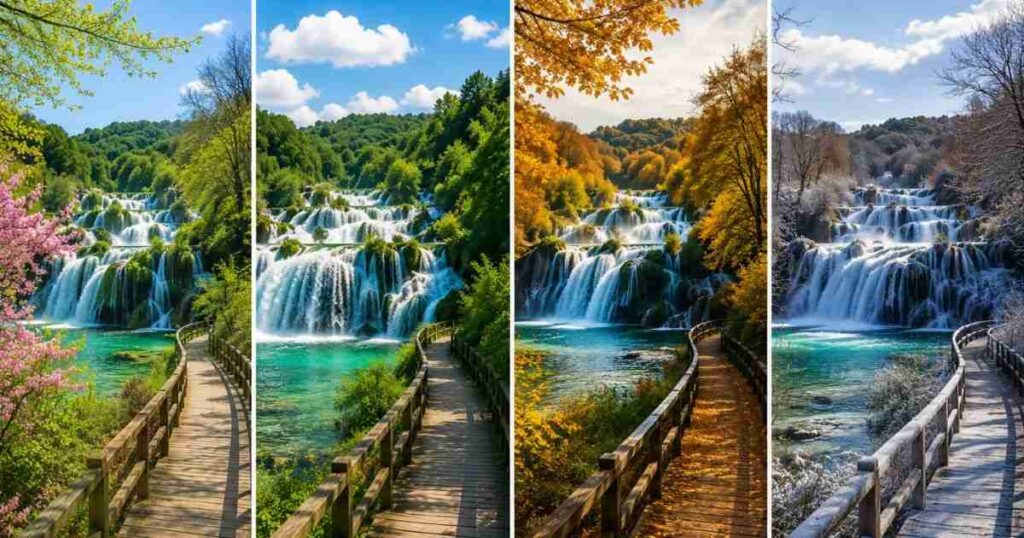
May and September are the strongest months for the split to Krka national park experience. In May, snowmelt from the Dinaric Alps pushes the Krka River to full volume Skradinski Buk runs at maximum power, the spray radius extends 15–20 meters from the main cascade and daily visitor numbers stay below 1,500. September brings warm air temperatures of 22–26°C, clear water visibility and crowds roughly 45% smaller than peak summer levels.
June works well on weekdays. Croatian school holidays begin in late June and weekend crowds start building toward summer levels. If you plan a June visit, Tuesday through Thursday are noticeably quieter than Friday through Sunday.
July and August are the most difficult months. Daily visitor counts regularly exceed 4,000. The Skradinski Buk boardwalk becomes a slow queue by 10 AM. Parking at Lozovac fills completely by 9:30 AM on summer weekdays and by 9:00 AM on weekends. Temperatures hit 35–38°C on the lower trail with minimal shade. None of this makes the trip impossible but arriving before 8:00 AM is the non-negotiable requirement for a summer visit.
Swimming at Skradinski Buk was banned in 2021 to protect the travertine formations. Most people who visit in summer looking to swim do not find out until they arrive. Designated swimming areas exist in the Krka River near Skradin town, outside the park boundary local residents use these spots regularly and they are completely free.
Winter visits between November and March offer empty trails, €10 entry fees and dramatically different canyon light. The park operates on reduced hours (9 AM–4 PM) and some boat services do not run but the travertine moss turns an almost electric shade of green in the low winter sun.
Pro Tip: Check the Krka National Park official website weather and water level notices the day before your visit. Autumn rainfall can raise river levels and temporarily close sections of the lower boardwalk. It is genuinely dramatic to see but you want to know in advance if half the trail is underwater.
What 90% of Day-Trippers from Split Never See
The split to Krka national park day trip for most visitors starts and ends at Skradinski Buk. Walk the 3.5 km loop, take photos, eat a sandwich, get back on the bus. That is a fine afternoon but it skips two things that require no extra effort and cost almost nothing.
Roški Slap is a second major waterfall 12 km north of Skradinski Buk along the Krka River. It is wider and less vertical than Skradinski Buk, surrounded by intact 18th-century watermills where the stone grinding mechanisms still function in spring. On a normal summer day, Roški Slap receives fewer than 200 visitors while Skradinski Buk hosts 4,000. Getting there requires either a river boat from Skradinski Buk (€10–€15 extra, 45 minutes each way) or driving north from Lozovac and entering through the Miljevci plateau entrance. Budget two additional hours.
Visovac Island monastery sits in the middle of the Krka River between the two waterfalls. Franciscan monks have lived there continuously since 1445. The monastery museum holds an original 1490 printed edition of Aesop’s Fables, one of only three confirmed surviving copies in the world. The boat excursion costs €15 and takes 45 minutes including the island stop. Almost nobody on a standard Split to Krka day tour visits it.
The old mill buildings at the base of Skradinski Buk have small working exhibitions of traditional Dalmatian grain milling. Most visitors walk past them in under a minute. Spend 10 minutes the wooden water-wheel mechanisms are original, still turning and the miller explanation boards are genuinely interesting if you read them.
Pro Tip: If you want Roški Slap and Skradinski Buk in a single day, arrive at the park by 8 AM, walk Skradinski Buk first while crowds are light, then take the river boat north. You will be back at the exit by 4–5 PM with time to eat in Skradin before returning to Split.
Practical Tips for the Split to Krka Day Trip
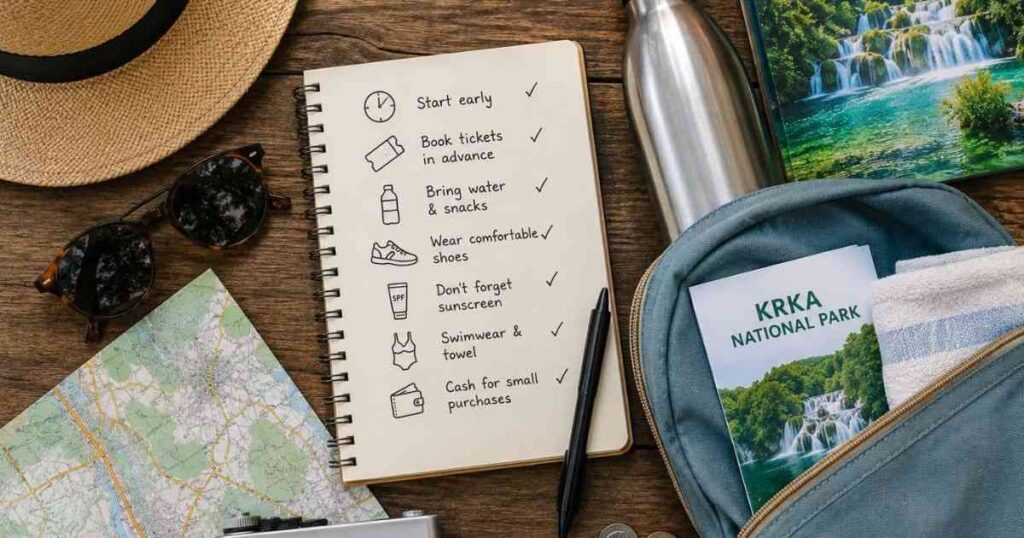
Footwear matters more than most guides admit. The Skradinski Buk boardwalk is paved and flat. The connecting paths between upper and lower sections involve uneven stone steps that become genuinely slippery from waterfall mist. Closed-toe shoes with grip are the right choice. Flip-flops cause twisted ankles and falls every single week in summer park staff see it constantly.
Food inside the park offers limited choices. One café near Skradinski Buk sells sandwiches for €4–€6 and water for €2. Bring your own lunch if you want a proper meal. The better option is to eat in Skradin town before or after the park. Konoba restaurants along the waterfront serve grilled fish, peka dishes and local wine for €18–€25 per person for a full meal.
Parking at Lozovac costs €3–€5. In peak summer it fills completely by 9:30 AM on weekdays and 9:00 AM on weekends. If you arrive late and cannot find a space, staff direct you to overflow areas 1–2 km away with connecting shuttle buses. Skradin town has a larger public car park that rarely fills completely, which is another practical reason to consider the boat entry route.
The mobile signal inside the Krka canyon is weak and drops completely in several lower sections. Download the offline park map from np-krka.hr before you leave Split. Knowing which trail fork leads to the boat dock versus the shuttle stop saves 20 minutes of confused backtracking.
Compared to Plitvice Lakes, the split to Krka national park trip is 1 full hour shorter from Split, €5–€10 cheaper on entry and puts you physically closer to the waterfalls. Plitvice offers 16 interconnected lakes and more total trail distance but it requires a 2.5-hour drive from Split. For a single day trip from the city, Krka wins on time, access and logistics.
Pro Tip: Carry at least 1.5 liters of water per person, even in mild weather. The lower trail sections trap heat in summer and there are no water refill points on the boardwalk itself.
You may also like:
Best Things to Do in Split, Croatia
Frequently Asked Questions
How many days do you need for a split to Krka National park visit?
One full day covers Skradinski Buk thoroughly if you arrive before 9 AM. Two days allows you to add Roški Slap and Visovac Island without rushing. Most visitors from Split complete the main waterfall trail in 3–4 hours and return to the city the same evening.
Is the split to Krka national park day trip worth it?
The split to Krka national park trip is worth every euro for visitors on the Dalmatian coast. Skradinski Buk is one of the most accessible large waterfall systems in all of Europe and the boardwalk puts you within meters of the main cascades. The €20–€30 entrance fee is on the higher end for Croatia but trail quality, infrastructure and the canyon boat ride justify the cost.
What is the best time of year to visit Krka National Park?
May and September offer the best conditions strong water flow, temperatures between 20–26°C, entrance fees of €20 rather than €30 and crowds at 40–50% of peak summer levels. June works well on weekdays. Avoid July and August unless you arrive before 8:30 AM.
How much does a full day trip from Split to Krka cost?
A budget day trip from Split to Krka costs €38–€45 per person: bus to Šibenik and taxi to park (€12–€16 return), entrance fee in shoulder season (€20) and a basic lunch (€6–€10). Driving and splitting costs between two people brings the total to roughly €32–€38 per person including fuel, tolls, parking and entry.
Is Krka National Park better than Plitvice Lakes for a day trip from Split?
For visitors based in Split, the split to Krka national park day trip is the stronger choice. Krka is 1 hour closer, €5–€10 cheaper to enter and places you directly alongside the waterfalls rather than viewing them from elevated walkways. Plitvice is more visually diverse across its 16 lakes and better suited to visitors staying in Zagreb or Zadar. If you have one day and are based in Split, choose Krka.
Conclusion
The split to Krka national park day trip rewards the people who treat it like a morning expedition rather than a midday tourist outing. Skradinski Buk at 8 AM light entering the canyon at a low angle, boardwalk nearly empty, mist hanging over the upper pools is a genuinely different place from the same waterfall at noon with 3,000 people pressed against the railings. The park is not a secret but the version of it that most visitors never experience absolutely is.
Book your tickets at np-krka.hr the night before, set your alarm for 6:00 AM and take the boat from Skradin through the canyon on the way in. That 25-minute ride through limestone walls with the river completely still around you is the part of the split to Krka national park trip that stays with you long after the waterfall photos stop surprising you.

