
Most people who visit Oahu spend their time on crowded beaches or at Manoa Falls, a maintained, paved trail with restrooms and a snack shop. Lulumahu Falls is the opposite: an unsanctioned trail with no restrooms, no water fountains and no other amenities and that is exactly what makes it worth hiking. Lulumahu Falls is one of the most straightforward hikes through lush forest to a towering two-tier waterfall and most tourists never find it. This guide covers everything you need before you lace up your boots the trail route, the permit process, parking, stream crossings, safety tips and what most visitors get wrong on their first attempt.
In This Guide You Will Find:
- Exact trailhead location and how to navigate the confusing early splits
- How to get the required DLNR permit before you arrive
- What to expect at each stage of the 2-mile round trip trail
- How Lulumahu Falls compares to Manoa Falls and which one to choose
- Safety warnings about leptospirosis, muddy terrain and parking theft
- The best months to hike and when to avoid it after rain
QUICK INFO BOX
| Detail | Info |
| Location | Nuuanu Valley, Honolulu, Oahu, Hawaii |
| Nearest Airport | Daniel K. Inouye International Airport (HNL) 10 miles / 20 min drive |
| Best Time to Visit | May through September (drier conditions, safer crossings) |
| Travel Time from Waikiki | 20–30 minutes by car (8 miles via Pali Highway) |
| Days Recommended | Half-day (3–4 hours total including drive) |
| Average Daily Cost | $0–$20 (free permit + optional car rental cost) |
What Makes Lulumahu Falls Worth the Mud and the Effort
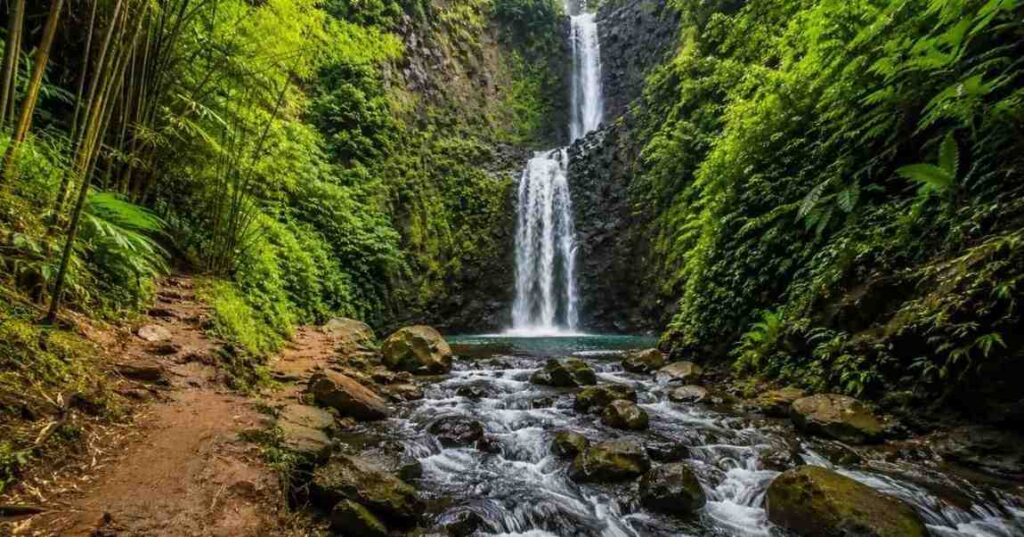
Lulumahu Falls is one of Oahu’s most popular unsanctioned hiking trails, a short 2-mile round trip that is more like a cross-fit training course than a hiking trail. The route takes you through a dense bamboo forest, across multiple stream crossings, over giant boulders and ends at the base of an impressive waterfall. The falls appear rather suddenly from around a bend after a mile of meandering, with multiple tiers, two of which you can see from the pools below, fed from the flanks of Konahuanui. Most visitors don’t realize the waterfall has two separate tiers visible from ground level the upper cascade and the lower drop which makes the final reveal genuinely surprising.
The Lulumahu Falls hike has an incline of approximately 160 meters, taking hikers to an elevation of 305 meters above sea level. The terrain shifts constantly flat bamboo groves give way to muddy stream banks, then rocky gulch walls close in around you as you near the falls. The trail can be muddy with tricky navigation reviewers strongly recommend sturdy shoes and starting early. The hike rewards hikers who pay attention to the trail markers rather than just following the crowd, because the crowd often goes the wrong direction.
There had to have been 20–30 people hanging around the base of Lulumahu Falls on a typical weekend morning so arriving before 8:00 AM gives you the falls nearly to yourself for at least the first 30 minutes.
Pro Tip: Download the AllTrails map offline before you leave your car. Cell signal drops inside the gulch and the trail splits multiple times with no signage at the critical junctions.
How to Get to Lulumahu Falls Trailhead and the Permit You Need
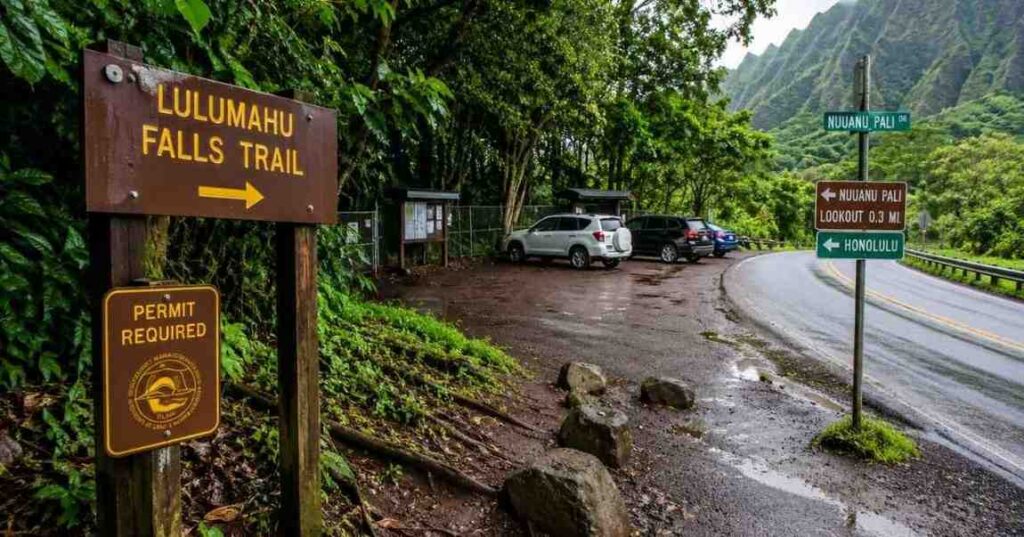
The Lulumahu Falls trailhead is at 4459 Pali Hwy, Honolulu, HI 96817 coordinates 21.353880, -157.811334. Parking is in a small dirt lot between the trees and the fence, at the corner of Nuuanu Pali Drive and Pali Highway. If you reach the Pali Lookout, you have gone 0.3 miles too far and need to turn around. The parking area is approximately 8 miles from Waikiki and takes 20–30 minutes to drive depending on traffic.
Here is what most hikers skip and later regret: a Hawaii DLNR permit is required to enter, as this is state watershed land. While citations are not common at this site, permits can be obtained for legal access to the trail. You can get the permit online through the Hawaii Division of Forestry and Wildlife. It is free and takes less than five minutes. The land is owned by the Honolulu Board of Water Supply, which is why the trail passes directly by the Nu’uanu Reservoir. If you don’t have a car, you can take bus number 13 from Ala Moana Center toward Liliha, get off at Vineyard Blvd + Nuuanu Ave, then transfer to bus number 4 (Nuuanu-Dowsett) and get off at Nuuanu Pali Dr + Puiwa Rd from there it is a short walk to the trailhead.
One critical parking warning: this parking lot is a crime hotspot because thieves know tourists will be gone for at least two hours. It is very common to see broken glass from smashed windows on the ground. Remove every single item from your car and don’t leave anything visible inside.
Pro Tip: Get your DLNR permit at least one day before your hike at trails.ehawaii.gov it is free but the office can be slow on weekday mornings and you do not want to skip this step.
Trail Route, Stream Crossings and How to Navigate Lulumahu Falls
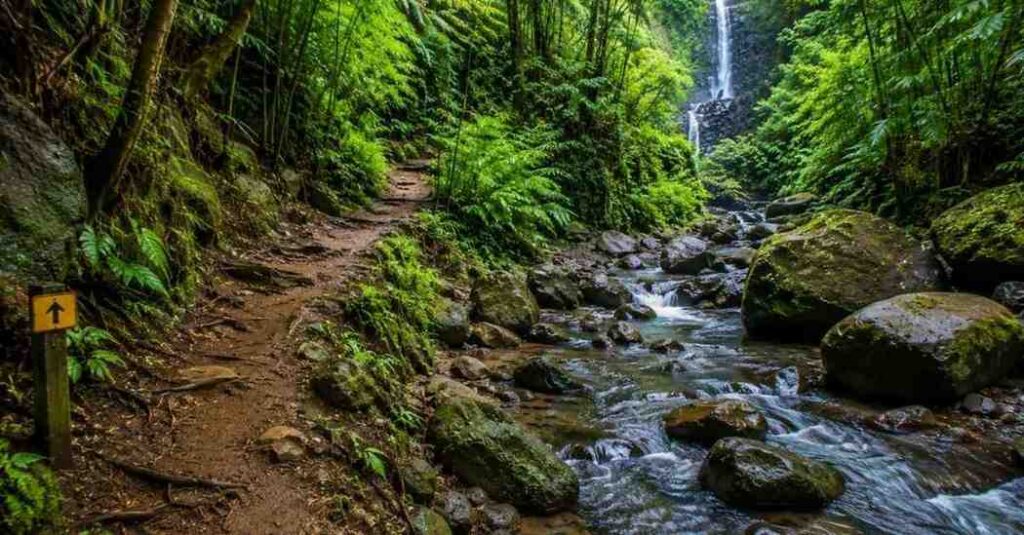
Immediately after beginning the hike, the Lulumahu Falls Trail splits. Go right, then right again at both splits, to follow the trail through the bamboo to the service road, about 0.1 miles away. This first section through the bamboo is flat and fast most hikers cover it in under 15 minutes. When the trail reaches the service road, go left to continue hiking toward Lulumahu Falls. When the road splits again with a very obvious path on the left-hand side, going straight the trail to the left leads the wrong way.
At the reservoir, the trail climbs the dam and heads along the dirt road, past the tower structure and barbed-wire catwalk. At the end of the reservoir, there are stairs leading up to the right, following the stairs and narrow path up as it makes its way through a fenced enclosure and out the other side. With about 0.2 miles left before Lulumahu Falls, the trail reaches the most important junction on the hike this is where hikers get off-track daily. The Lulumahu Falls Trail drops steeply down to cross the stream, while the wrong path stays on the easier route to the left. Go right to cross the Lulumahu Stream.
The pools below the falls are shallow and small but wading in them is a refreshing break from the tropical heat. The falls have multiple tiers, two of which can be seen from the pools below. The total round trip takes most hikers between 2 and 3 hours.
Pro Tip: Follow the pink ribbons tied to branches to mark the correct path through the densely forested sections near the stream crossings.
Lulumahu Falls vs Manoa Falls: Which Waterfall Hike Should You Do?
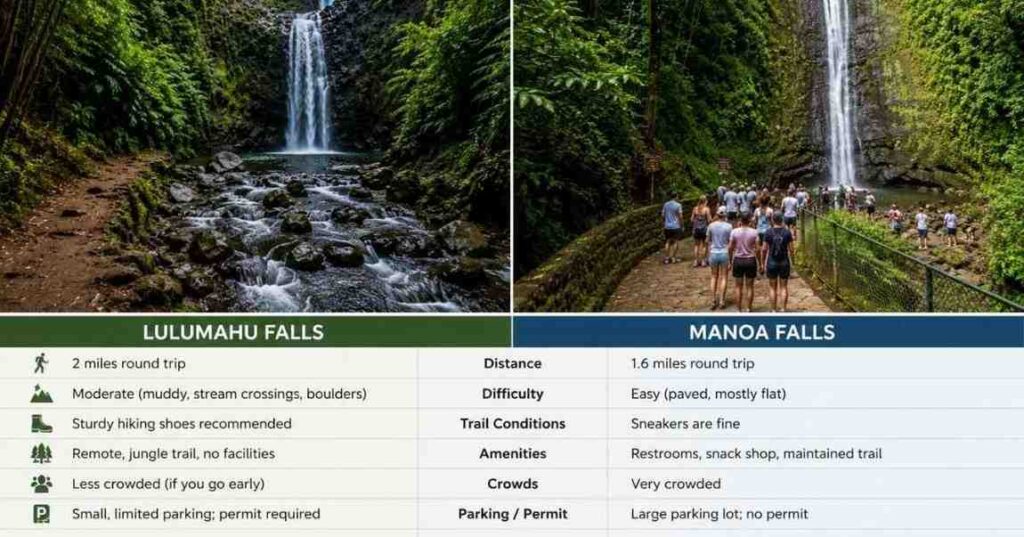
Lulumahu Falls and Manoa Falls are close to each other and similar in length. The main difference is that Manoa Falls is a maintained hike with restrooms, a small store and a snack shop and Manoa Falls is 150 feet tall. Lulumahu Falls is an unsanctioned trail with no amenities and includes stream crossings that Manoa Falls doesn’t have.
Manoa Falls charges a $5 parking fee and attracts tour buses. Lulumahu Falls costs nothing to hike (beyond the free permit) and attracts hikers who want a genuine trail experience rather than a paved walkway. Many first-time Hawaii visitors hike to Manoa Falls which means Lulumahu Falls stays comparatively quieter despite its growing popularity. If you want a waterfall you can reach in flip-flops, go to Manoa. If you want mud on your boots and a trail that actually challenges you, Lulumahu Falls is the right choice. The two trailheads are roughly 3 miles apart, so hikers staying in Honolulu could theoretically visit both in one day but most people find that one waterfall hike is enough for a single morning.
Verdict: Choose Lulumahu Falls if you want a raw, uncrowded trail experience. Choose Manoa Falls if you are hiking with young children or elderly family members who need paved access and facilities.
Safety, Best Seasons and What to Bring to Lulumahu Falls
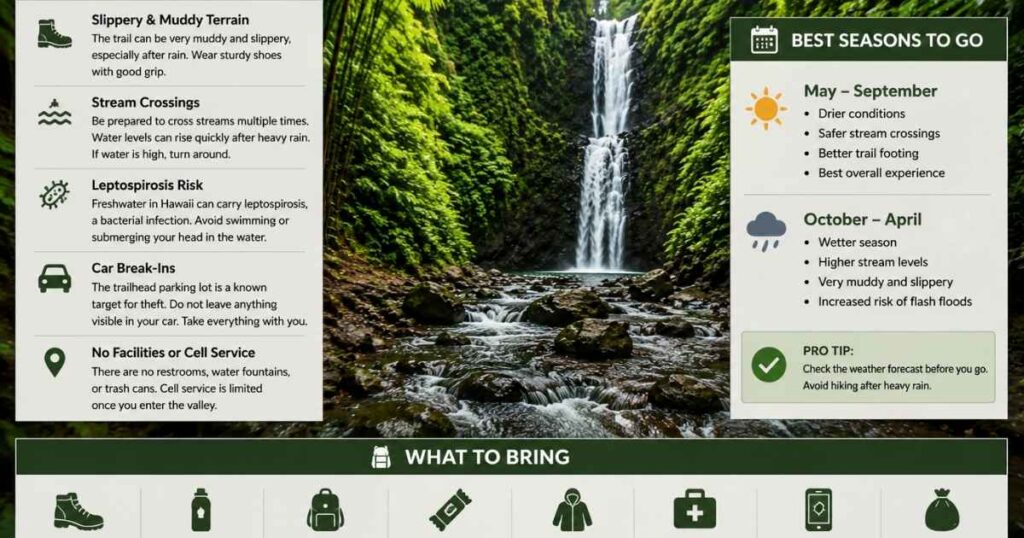
Although the waterfall pool is tempting on a hot day, do not swim in it. A bacterial disease called leptospirosis lives in freshwater in Hawaii and can make you seriously ill. This applies to every freshwater stream and pool on the Lulumahu Falls trail the stream crossings are for walking through, not for sitting in. The trail gets its moderate difficulty rating because of slippery stream crossings. Be sure to wear shoes with good traction, not flip-flops. Waterproof shoes are strongly recommended.
East-side hikes are prone to rain regardless of the season and pack a light rain jacket. The best months to hike Lulumahu Falls are May through September, when Oahu’s trade winds keep rainfall lower on the windward side. Do not go after recent rain as the trail gets very muddy however, the waterfalls run stronger during the rainy season. The winter months of November through February bring heavier rain, which makes the stream crossings faster-moving and the boulders more slippery. For a first visit, aim for a dry weekday in June, July or August and arrive at the trailhead by 7:30 AM.
Packing list: at least 1.5 liters of water per person, trail shoes with grip, bug spray, a change of socks, a dry bag for your phone and a snack for the base of the falls.
Pro Tip: Bring a towel and a change of shoes so you don’t track mud into your car. You will finish the Lulumahu Falls hike wet from at least the knee down on almost any day of the year.
You may also like:
Big Island Waterfalls You Can Swim In
Best Things to Do in Kona Hawaii
Best Mauna Kea Stargazing Tour
Frequently Asked Questions
How long does it take to hike Lulumahu Falls?
The Lulumahu Falls hike typically takes about 2 hours to complete, depending on your hiking speed and the number of stops you make. Add 30 minutes if you plan to rest at the base of the falls and eat a snack. Most hikers return to their cars within 2.5 to 3 hours of starting.
Is a permit required to hike Lulumahu Falls?
Yes, a Hawaii DLNR permit is required to enter, as Lulumahu Falls sits on state watershed land. The permit is free and available online at trails.ehawaii.gov. Hiking without a permit is technically trespassing on Honolulu Board of Water Supply property, even though enforcement is infrequent.
What is the best time of year to visit Lulumahu Falls?
The best months to hike Lulumahu Falls are May through September when rainfall is lower and the stream crossings are calmer. The waterfalls run stronger during the rainy season (November–February) but the trail becomes significantly more dangerous in wet conditions. Dry-season mornings before 8:00 AM give you the lightest crowds and the coolest temperatures.
How difficult is the Lulumahu Falls hike?
The Lulumahu Falls hike is rated moderate due to muddy sections, uneven terrain, stream crossings and rock navigation. It is suitable for most hikers but not recommended for the elderly or complete beginners. The elevation gain of 160 meters happens gradually but the slippery stream crossings near the end are where most people struggle.
Is Lulumahu Falls better than Manoa Falls for experienced hikers?
For experienced hikers, Lulumahu Falls is the stronger choice it has no paved surfaces, requires real navigation and involves multiple stream crossings that Manoa Falls does not have. Manoa Falls stands 150 feet tall compared to Lulumahu’s 50-foot drop but Manoa is a maintained trail with a parking fee, restrooms and tour groups, which removes much of the adventure. Lulumahu Falls offers a trail that feels genuinely wild even though it is only 20 minutes from downtown Honolulu.
Final Thoughts
Lulumahu Falls is the waterfall hike that Oahu locals recommend when they want to test whether you are a real hiker or just a tourist with new boots. The 2-mile round trip route through bamboo, reservoir road, boulder scrambles and multiple stream crossings packs more variety into a single morning than most full-day hikes on the mainland. Get your free DLNR permit the night before, arrive at the trailhead by 7:30 AM on a dry morning, empty your car completely before you leave it and follow the pink trail ribbons past the critical junction where everyone turns left by mistake. Stand at the base of Lulumahu Falls, feel the cold mist hit your face and you will understand why this trail keeps pulling people back.

