
Most people picture Hawaii’s sand as white or black, so the first glimpse of Papakolea Green Sand Beach stops visitors mid-step. The color comes from olivine crystals, a mineral that forms in volcanic eruptions and erodes out of the surrounding cliff face. This beach sits at Mahana Bay, tucked below a cinder cone at the southernmost tip of the Big Island. This guide covers exactly how to reach Papakolea Green Sand Beach, what the hike really costs and which mistakes send half of the day’s visitors home without ever seeing the sand.
IN THIS GUIDE YOU WILL FIND:
– The real distance and difficulty of the hike to Papakolea Green Sand Beach
– Whether to pay for a shuttle truck or walk the coastal trail yourself
– The safest place to swim once you reach the water
– What most first-time visitors get wrong about timing and heat
– How Papakolea Green Sand Beach compares to Hawaii’s other colored-sand beaches
– Practical tips for parking, water and sun protection at South Point
QUICK INFO
Location: Ka Lae (South Point), Big Island, Hawaii
Nearest Airport: Hilo International Airport (ITO) about 75 minutes by car
Best Time to Visit: Weekday mornings; April–June and September–November for calmer winds and better conditions
Travel Time from Nearest Major City: About 45 minutes from Naalehu and roughly 2 hours from Hilo
Days Recommended: Half-day visit, often combined with other South Point attractions
Average Daily Cost: $5–$20 for transportation if driving yourself or around $20–$25 per person with a local driver or shuttle service
Getting to Papakolea Green Sand Beach
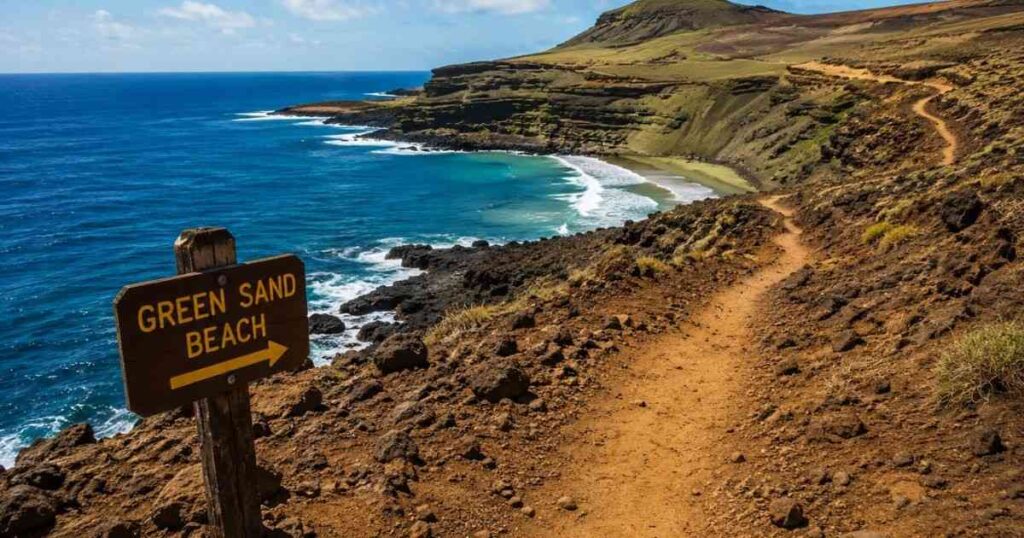
The beach sits about 2.5 miles from the parking area at South Point and there is no paved road down to the sand. You have two ways in: walk the dirt coastal trail yourself, which takes 45 to 60 minutes each way or pay a local driver 15 to 20 dollars round trip for a bumpy ride in the back of a pickup truck. The trail hugs the coastline the entire way, crossing open lava rock with almost no shade. Most visitors underestimate the heat here, since South Point sits exposed to constant wind and direct sun with zero tree cover.
Once you reach the rim above Mahana Bay, a steep, loose lava trail drops about 100 feet down to the beach itself. This descent is the part that turns people back, since the footing shifts under loose gravel and there is no railing. Wear closed-toe shoes with real tread, not sandals, because the final approach to Papakolea Green Sand Beach has claimed more twisted ankles than any other stretch of the hike.
Pro Tip: Bring at least 1.5 liters of water per person, since there are no stores, restrooms or shade stations anywhere along the 5-mile round trip.
Local drivers gather near the trailhead gate starting around 8 a.m. and most run their trucks until early evening, though service thins out after 4 p.m. as the light starts to fade. If you plan to walk instead, start no later than 9 a.m. so you finish the round trip before the strongest afternoon heat sets in. The dirt trail splits briefly near the halfway mark and the wider left fork follows the truck route while the narrower right fork cuts closer to the cliff edge with slightly better ocean views.
What Makes the Green Sand Green
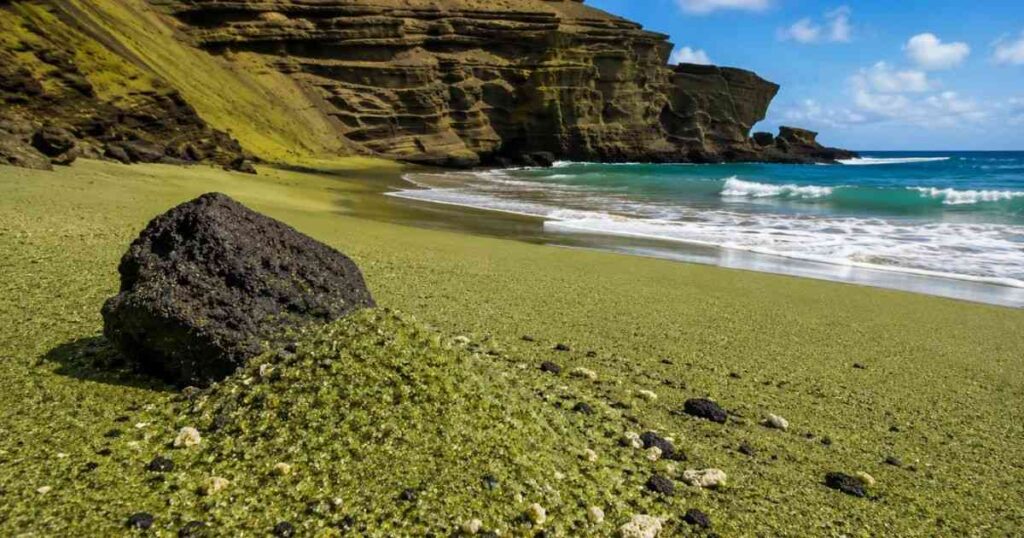
The green tint at Papakolea Green Sand Beach comes from olivine, a silicate mineral crystallized inside the Puu Mahana cinder cone roughly 49,000 years ago. As ocean waves erode the cinder cone’s exposed wall, they wash out the heavier olivine crystals while carrying away the lighter black basalt and white coral fragments. Only four green sand beaches exist on the planet and it is the most accessible of them, ahead of beaches in Guam, the Galapagos Islands and Norway.
The green color looks strongest in direct midday sun and fades to a duller olive tone under cloud cover, so timing your visit matters if photos are the goal. Up close, the sand feels coarser than typical white sand because olivine crystals are heavier and less rounded than quartz. Scoop a handful and you will notice black basalt grains and small coral chips mixed throughout, since the beach is a blend rather than pure green mineral.
Pro Tip: Visit between 10 a.m. and 2 p.m. when the sun sits high overhead, since this is when the olivine crystals show their deepest green color in photos.
Swimming and Safety at the Beach
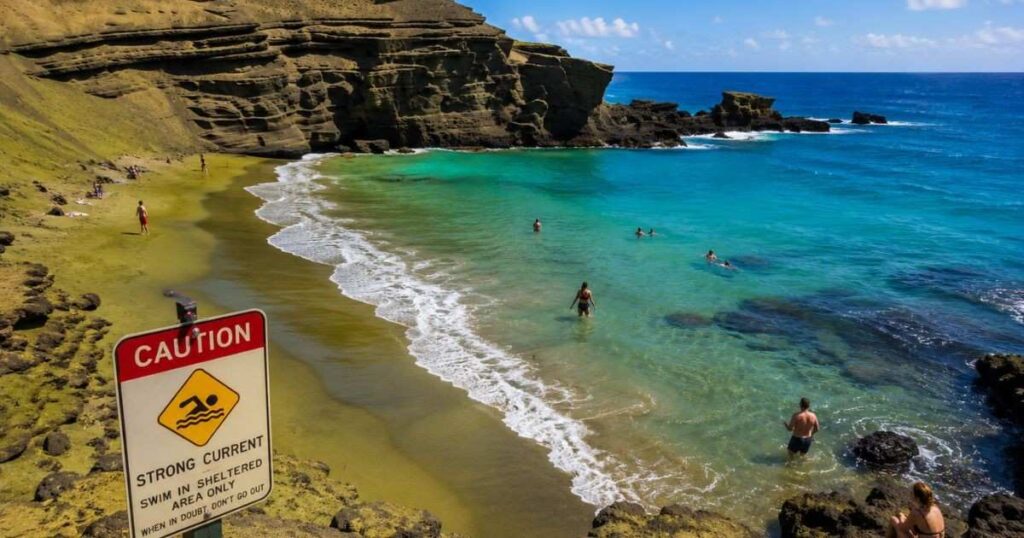
The bay at Papakolea Green Sand Beach curves into a semicircle and the calmest water sits along the inner crescent, away from the rocky points on either side. Currents pick up fast once you move past the inner curve and South Point is known locally for a strong offshore pull called the Halaea current, named after a chief swept out to sea here centuries ago. Lifeguards do not staff this beach, so swim only within the sheltered middle section and skip the water entirely when waves exceed 2 feet.
Locals recommend checking wind conditions before the hike, since anything above 20 mph kicks up enough sand and surf to make swimming unsafe at this beach. Morning visits typically bring calmer water than afternoon, when trade winds strengthen across South Point. Bring reef-safe sunscreen, since this stretch of coastline sits inside a conservation zone where regular sunscreen chemicals damage the surrounding reef.
Pro Tip: Test the current by wading knee-deep first and turn back immediately if you feel a pull toward the rocky edges of the bay.
Papakolea Green Sand Beach Compared to Other Hawaii Beaches
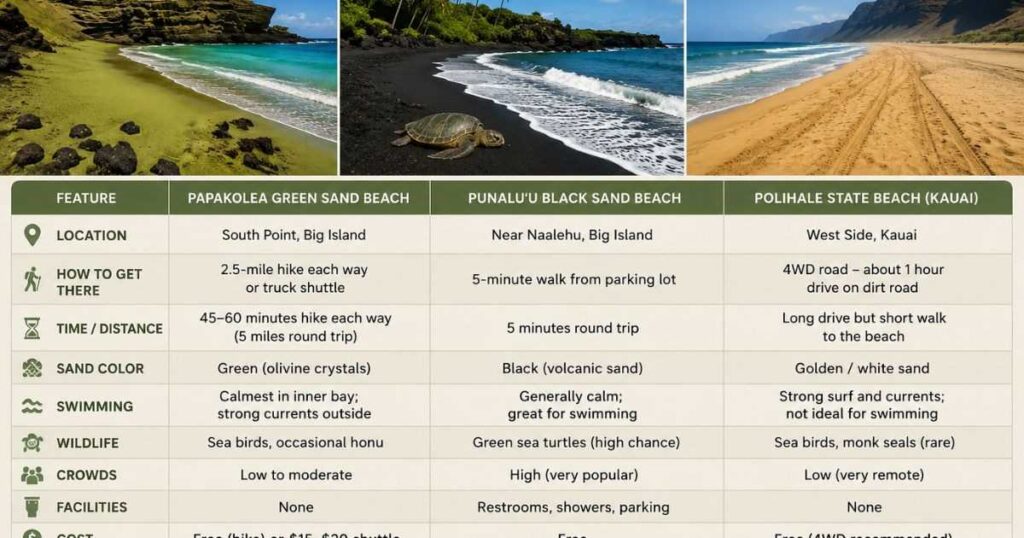
Big Island visitors often cross-reference this stop with Punaluu Black Sand Beach near Naalehu, about 25 minutes away, which has actual parking, restrooms and resident green sea turtles. Punaluu takes 5 minutes to reach from the road, while Papakolea Green Sand Beach demands a 2.5-mile hike each way, so families with young kids or limited mobility usually get more value from Punaluu. For travelers who want a rarer, more remote reward, this beach delivers a color and story that Punaluu cannot match.
Compared to Kauai’s Polihale State Beach, another remote Hawaii shoreline reached by rough terrain, Papakolea Green Sand Beach is shorter to access but far more physically demanding due to the descent into Mahana Bay. Most travelers pair a visit to this beach with the South Point cliffs, where locals cliff-jump into 40-foot-deep water and the nearby Kaulana Bay boat ramp, one of the oldest fishing harbors on the island.
Verdict: Choose Papakolea Green Sand Beach if you want a genuinely rare geological sight and can handle a 5-mile round-trip hike in full sun; choose Punaluu if convenience and turtle sightings matter more than color rarity.
Practical Tips for Visiting
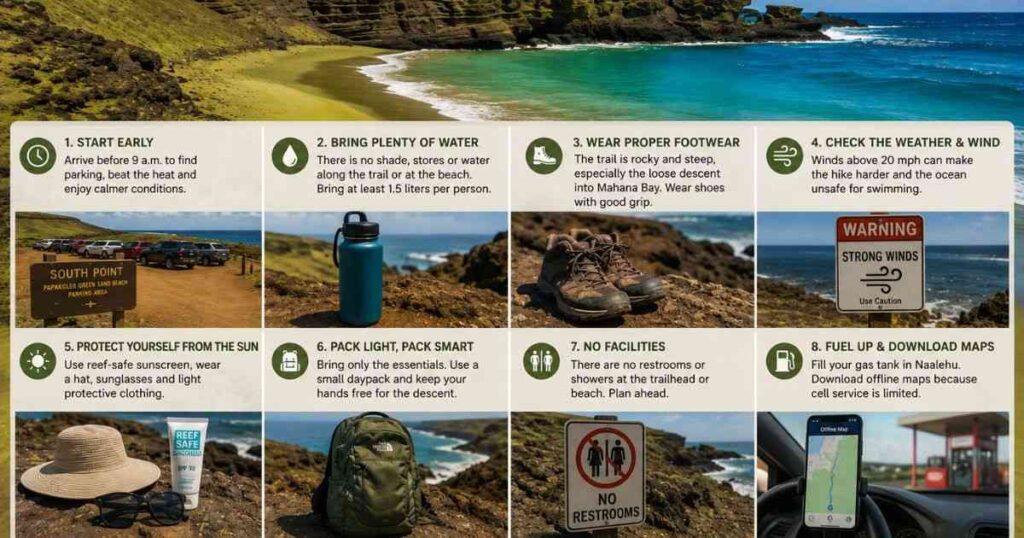
Parking at the South Point trailhead is free and unpaved and the lot fills up by mid-morning during peak travel months, so arriving before 9 a.m. secures an easier walk-in spot. Cell service disappears almost entirely once you pass the parking area, so download offline maps of the trail before you leave Naalehu. There are no restrooms at the trailhead or the beach and the nearest facilities sit at the Naalehu Fruit Stand, about 20 minutes back toward Highway 11.
If you choose the truck shuttle instead of walking, negotiate the fare before climbing in, since drivers set informal prices that range from 15 to 20 dollars per person round trip. The ride cuts the 45-minute walk down to about 10 minutes each way, though the unpaved, rutted road makes for a rough, bouncing trip. Pack a light daypack rather than a full backpack, since the descent into Mahana Bay requires both hands free for balance on the loose lava rock.
Pro Tip: Fill your gas tank in Naalehu before heading to South Point, since there are no gas stations for miles in either direction near the trailhead.
Pack light and pack smart: a hat with a chin strap, polarized sunglasses and a dry bag for your phone all earn their weight on this trip. The wind at South Point gusts hard enough to knock loose items out of an open bag, so zip everything shut before you start the descent into the bay. If you plan to swim, bring a change of dry clothes for the drive back, since there is nowhere to rinse off or change once you leave the beach.
You may also like:
Best Things to Do in Kona Hawaii
Frequently Asked Questions
How many days do you need for Papakolea Green Sand Beach?
You only need half a day to visit this beach, including the drive to South Point, the hike or shuttle ride and time at the water. Most travelers combine it with a stop at the South Point cliffs and Punaluu Black Sand Beach on the same day. Budget 3 to 4 hours total if you plan to hike both directions.
Is Papakolea Green Sand Beach worth visiting?
Yes, Papakolea Green Sand Beach is worth visiting because it is one of only four green sand beaches on Earth and the most accessible of them by far. The unique olivine sand and the dramatic South Point setting make the hike worthwhile for anyone comfortable with rough terrain. Travelers seeking convenience over rarity may prefer Punaluu Black Sand Beach instead.
What is the best time to visit Papakolea Green Sand Beach?
The best time to visit is a weekday morning between April and June or September and November, when winds stay calmer and crowds thin out. Arriving before 9 a.m. also means cooler hiking temperatures and easier parking. Midday sun between 10 a.m. and 2 p.m. shows off the green color best for photos.
Is Papakolea Green Sand Beach expensive to visit?
No, this beach costs nothing if you hike the 2.5-mile trail yourself, since parking and trail access are free. The only cost comes from an optional truck shuttle, which runs 15 to 20 dollars per person round trip. Total daily costs, including gas and a shuttle ride, usually stay under 25 dollars per person.
Can you do a day trip to Papakolea Green Sand Beach from Hilo?
Yes, Papakolea Green Sand Beach works well as a day trip from Hilo, since the drive takes about 2 hours each way along Highway 11. Combining the visit with Punaluu Black Sand Beach and the South Point cliffs makes for a full day of Big Island sightseeing. Leaving Hilo by 7 a.m. gives enough time for the hike, the beach and the return drive before dark.
Final Thoughts
Few beaches anywhere reward a rough hike the way Papakolea Green Sand Beach does, since the olivine crystals scattered across Mahana Bay exist almost nowhere else on the planet. The combination of the exposed South Point trail, the steep drop into the bay and the strange green shoreline waiting at the bottom makes this one of the Big Island’s most memorable stops. Skip the shuttle if you can, since the 45-minute coastal walk gives you time to spot the cliffs where locals jump into the deep water below. Once you reach the sand, sit at the water’s edge for a few minutes and watch the crystals catch the light before you make the climb back up.

