
Most people assume the drive from Flagstaff to Grand Canyon takes half the day. It doesn’t. On a clear morning, you can leave your hotel on Route 66, watch the pines thin out into open plateau and be standing at Mather Point with a coffee still warm in your hand. The Flagstaff to Grand Canyon route is one of the shortest, easiest approaches to the South Rim in the entire state and that simplicity is exactly why so many travelers base themselves in Flagstaff instead of camping closer to the park gate.
This guide covers everything you need before you make the Flagstaff to Grand Canyon drive: the fastest route, the scenic alternative, how long it actually takes, where to stop, when to go and what it costs.
In this guide you will find:
- The two main routes for driving from Flagstaff to Grand Canyon and how they compare
- Real drive times, including traffic and weather delays
- The best places to stop along the way for food, photos and fuel
- Seasonal advice on when the road and the park are at their best
- Entrance fees, parking realities and how to avoid the busiest hours
- Answers to the questions most first-time visitors ask before the trip
Quick Info
Location: South Rim, Grand Canyon National Park, Arizona
Nearest Airport: Flagstaff Pulliam Airport (FLG), about 90 minutes by car from the South Rim
Best Time to Visit: Late April through early June or mid-September through October for mild weather and smaller crowds
Travel Time from Flagstaff: About 1 hour 30 minutes via US-180 and AZ-64
Days Recommended: 1 day for the main viewpoints, 2 to 3 days if you plan to hike below the rim or explore nearby attractions
Average Daily Cost: $120 to $180 per person, including park entry, meals and a mid-range hotel in Flagstaff
This quick info box covers the essentials before planning your Grand Canyon South Rim visit.
Getting From Flagstaff to Grand Canyon: Routes and Drive Time
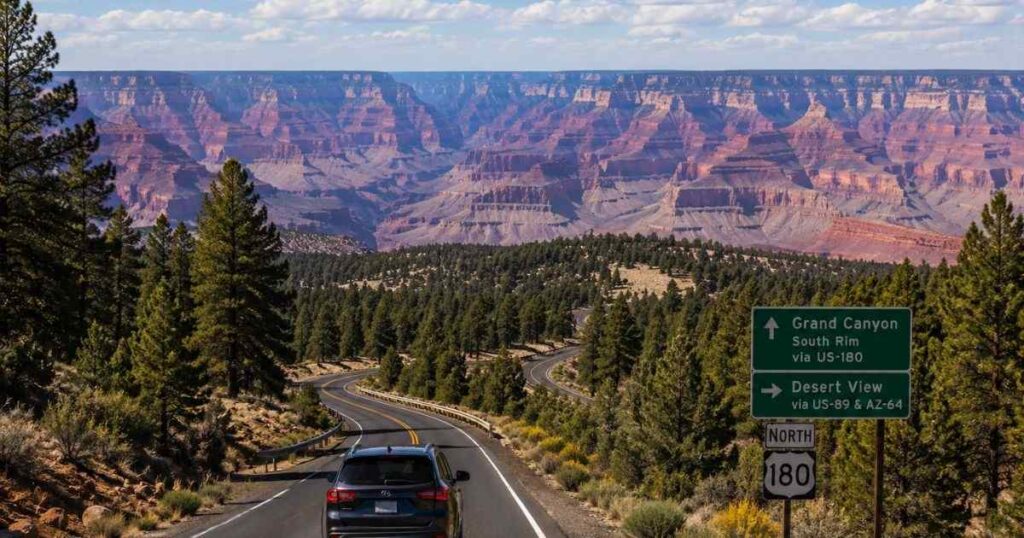
There are two practical ways to make the trip from Flagstaff to Grand Canyon and picking the right one shapes your whole day. The first is US-180 North, a 90-mile drive that takes about 1 hour and 30 minutes without stops. This road cuts through Kaibab National Forest, past the base of the San Francisco Peaks and delivers you straight to the South Rim’s Grand Canyon Village entrance.
The second option combines US-89 North and State Route 64, a slightly longer 110-mile route that takes closer to 2 hours. This path runs through Cameron, home to the Cameron Trading Post and enters the park from the east through the Desert View entrance. Drivers who take this route pass Desert View Watchtower first, which sits 25 miles from the main village area.
Both routes from Flagstaff to Grand Canyon are paved and well-maintained year-round, though winter storms occasionally slow traffic on US-180 above 7,000 feet elevation. Google Maps and most GPS apps default to the US-180 route since it saves roughly 30 minutes, though both roads work fine for a comfortable Flagstaff to Grand Canyon trip.
Pro Tip: If you want to see Desert View Watchtower and the eastern canyon overlooks, take the US-89/64 route on the way there and return via US-180 for a loop instead of backtracking the same road twice.
What the Trip Actually Costs
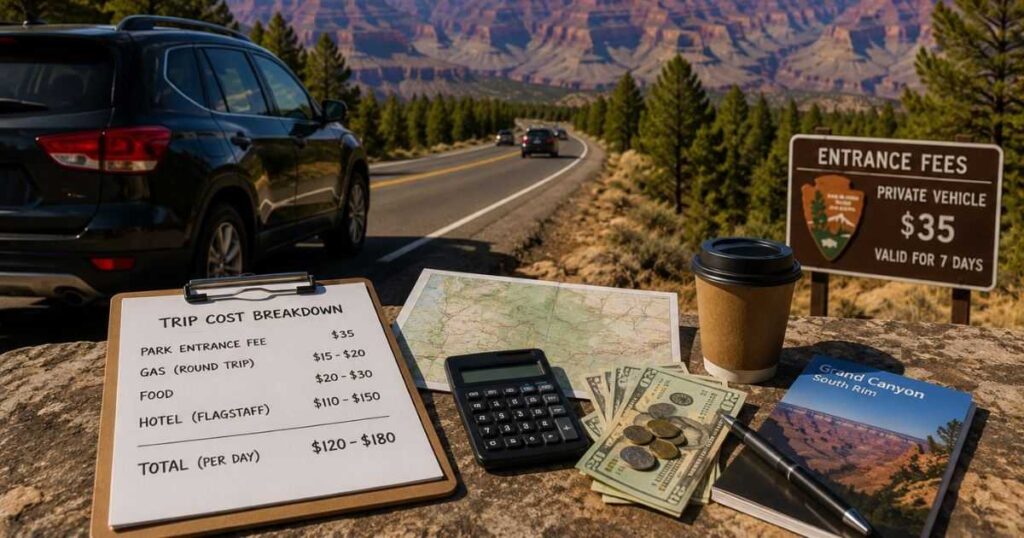
A day trip from Flagstaff to Grand Canyon costs less than most visitors expect if they plan ahead. The park entrance fee is $35 per private vehicle, valid for seven consecutive days or $70 for an annual pass covering every national park in the country. Gas for the round trip on US-180 runs roughly $15 to $20 depending on your vehicle, since the round-trip distance is about 180 miles.
Food inside the park runs higher than in Flagstaff itself. A sandwich at Bright Angel Lodge costs around $14, while the same meal at a Flagstaff diner near downtown runs closer to $9. Many travelers pack a lunch in Flagstaff before the drive and save $20 to $30 for a family of four.
Lodging is where the real savings show up. A mid-range hotel in Flagstaff averages $110 to $150 a night, compared to $250 or more for lodges inside the park at Grand Canyon Village. This price gap is the single biggest reason travelers choose Flagstaff as a base rather than booking inside the park boundary.
Verdict: Basing yourself in Flagstaff and driving in for the day saves meaningful money on lodging without costing you much sightseeing time.
Best Time to Make the Drive
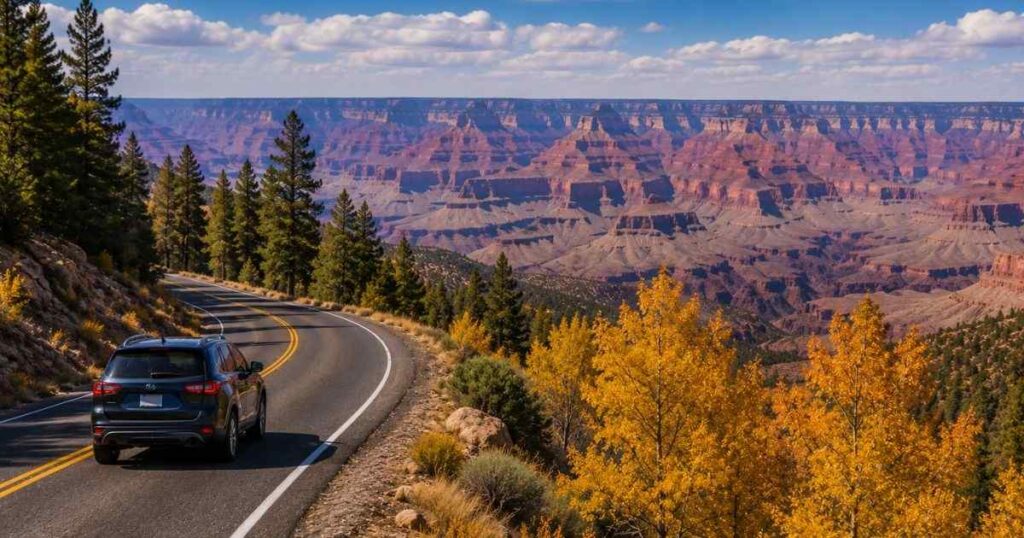
Timing changes everything about a Flagstaff to Grand Canyon trip. Late April through early June brings mild days in the 60s and 70s Fahrenheit at the rim, thinner crowds than summer and clear roads on both routes. September and October offer similar weather with the added bonus of aspen color turning gold along US-180 near the San Francisco Peaks.
July and August bring the heaviest crowds and afternoon monsoon storms that can reduce visibility on the drive. Lightning near the rim is common during these months, so plan viewpoint stops for morning hours instead of late afternoon. Winter, from December through February, transforms the drive: snow is routine on US-180 and Grand Canyon Village itself often sits under a light dusting that closes some trails but keeps the crowds away entirely.
Most visitors don’t realize the South Rim stays open all year, unlike the North Rim, which closes completely from mid-October through mid-May. If you’re set on a shoulder-season visit with fewer people, aim for a weekday departure from Flagstaff rather than a weekend, since Saturday traffic on US-180 can add 20 to 30 minutes each way.
Pro Tip: Leave Flagstaff before 7 a.m. in summer to reach the rim before the park’s parking lots fill, which typically happens by 10 a.m. at Grand Canyon Village.
Stops Worth Making Along the Way
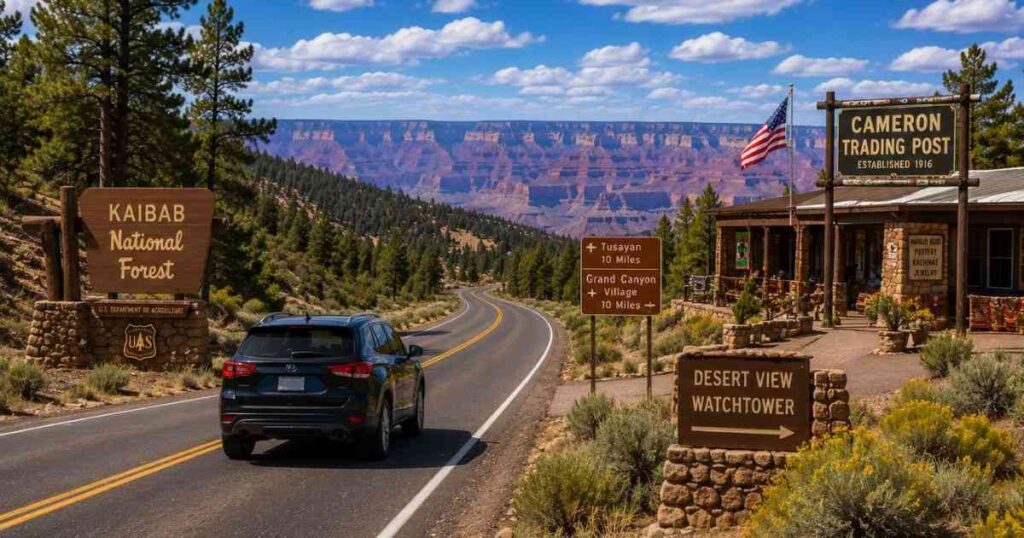
The drive from Flagstaff to Grand Canyon has more to offer than a straight shot up the highway. On the US-180 route, the Coconino National Forest overlook near mile marker 230 gives you a first glimpse of the high plateau opening up, a good five-minute photo stop with no crowds. Closer to the park, the Tusayan strip has gas stations, a small grocery store and the IMAX theater showing a 34-minute Grand Canyon film for $17 per adult.
If you choose the eastern route through Cameron, the Cameron Trading Post is worth 20 to 30 minutes on its own. It sells Navajo rugs, jewelry and pottery directly from local artists and the attached restaurant serves Navajo tacos for about $12. From there, it’s another 30 miles to Desert View Watchtower, a 70-foot stone tower built in 1932 that gives one of the widest canyon views on either route, without the crowds found at Mather Point.
Compared to the drive from Williams, which covers similar terrain but adds an extra 20 minutes each way, the Flagstaff to Grand Canyon route is more direct and has more worthwhile stops along the corridor. Williams does offer the Grand Canyon Railway experience, which some families prefer over driving altogether.
Verdict: Build in at least one stop each way, since the corridor between Flagstaff and the South Rim has more genuine attractions than most people expect from a “connector road.”
Practical Tips for the Day
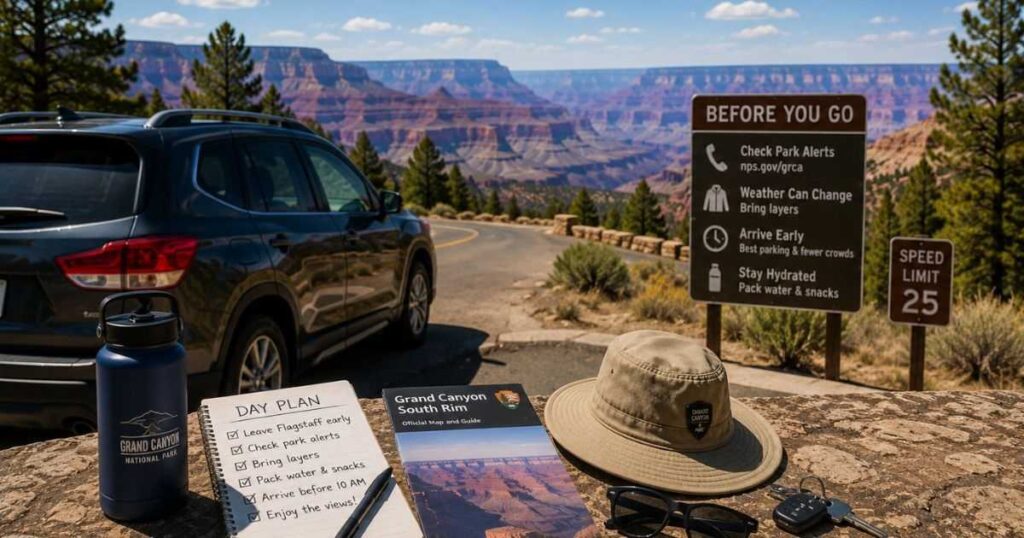
Fill your gas tank in Flagstaff before you leave. Prices inside Tusayan and near the park run 20 to 30 cents higher per gallon and there are long stretches with no stations at all on the eastern route through Cameron. Cell service drops in and out along both roads, so download offline maps before you go rather than relying on live navigation the whole way.
Parking at Grand Canyon Village fills fast between 10 a.m. and 3 p.m. from May through September. If you arrive during that window, park at the Grand Canyon Visitor Center lot and use the free shuttle system rather than circling for a spot near Mather Point. The shuttle runs every 10 to 15 minutes and covers the main viewpoints along Hermit Road, which is closed to private vehicles for most of the year.
Anyone making the Flagstaff to Grand Canyon trip for the first time should also check the park’s alert page for road closures before leaving, since construction occasionally narrows sections near the Tusayan entrance. Pack layers regardless of season. Temperatures at the rim run 15 to 20 degrees cooler than in Flagstaff and wind along the exposed viewpoints makes it feel colder still. A trip from Flagstaff to Grand Canyon in October might start at 75 degrees in town and end at 50 degrees on the rim by late afternoon.
Pro Tip: Buy your park pass online in advance through the National Park Service site to skip the entrance line, which can run 15 to 20 minutes deep on summer mornings.
You may also like:
Frequently Asked Questions
How long does it take to drive from Flagstaff to Grand Canyon?
The drive from Flagstaff to Grand Canyon takes about 1 hour and 30 minutes via US-180 or roughly 2 hours via US-89 and State Route 64 through Cameron. Add 20 to 30 minutes during summer weekends or winter storms. Most visitors budget a full day for the round trip plus sightseeing time at the rim.
Is a day trip from Flagstaff to Grand Canyon worth it?
Yes, a day trip is worth it for most travelers, since the South Rim’s main viewpoints are reachable within a few hours of arriving. You’ll see Mather Point, Yavapai Point and a stretch of the Rim Trail without needing an overnight stay. Travelers wanting sunrise or sunset photography at multiple viewpoints often prefer an overnight in Tusayan or Flagstaff instead.
What is the best time of year to drive from Flagstaff to Grand Canyon?
Late April through early June and mid-September through October offer the mildest weather and the clearest roads for the trip. Summer brings monsoon storms that can affect visibility on the drive, while winter can bring snow on US-180 above 7,000 feet. The South Rim stays open all year, so a winter visit is possible with proper tire chains or all-season tires.
Is the trip from Flagstaff to Grand Canyon expensive?
The core costs are a $35 vehicle entrance fee and $15 to $20 in gas for the round trip, making the drive itself inexpensive. Food and lodging costs vary widely depending on whether you eat and sleep in Flagstaff or inside the park boundary. Choosing Flagstaff for meals and a hotel over Tusayan or Grand Canyon Village lodges can cut a family’s total trip cost by more than half.
Is it better to stay in Flagstaff or drive from Williams to Grand Canyon?
Flagstaff generally wins on drive time and cost, since it sits closer to the South Rim entrance than Williams and offers more affordable hotels. Williams has the advantage of the Grand Canyon Railway, a scenic train alternative to driving that appeals to families with young children. If you want flexibility to explore multiple viewpoints on your own schedule, the Flagstaff to Grand Canyon drive gives you more control over your day.
Final Thoughts
The drive from Flagstaff to Grand Canyon remains one of the most straightforward national park trips in the American Southwest: short, scenic and easy to plan around any season. Whether you take the direct US-180 route or the slower path past Desert View Watchtower, you’ll reach the South Rim with time to spare for the viewpoints that make the trip worth the gas money. Don’t just glance at Mather Point and leave. Walk 15 minutes west along the Rim Trail to Yavapai Point, sit on the stone wall past the geology museum and watch the shadows shift across the canyon walls for at least half an hour before you head back to the car.

